Professional Pulse

Why Waiting for Campus Placement Isn’t a Career Strategy

For many students, the career plan looks something like this:

Study → Graduate → Sit for campus placement → Get a job.

And honestly, there is nothing wrong with campus placement.

If your college brings good companies and you get selected, that’s great.

But here’s the problem:

What happens if it doesn’t work out?

I’ve spoken to many students who spend their entire college life waiting for placement season. They focus on classes and exams, and only start thinking seriously about their career in the final semester.

Then placement season arrives.

Some students get selected.

Some don’t.

And suddenly, the students who didn’t get selected are left asking:

“What do I do now?”

That’s why I don’t think waiting for campus placement should be your entire career strategy.

Campus Placement Is an Opportunity, Not the Only Opportunity

Your college can help you access companies.

But opportunities also exist outside your campus.

You can:

  • Apply for internships directly.
  • Search for opportunities on LinkedIn and job platforms.
  • Reach out to startups and small companies.
  • Connect with professionals working in your field.
  • Participate in projects, competitions, workshops and communities.
  • Ask people in your network about opportunities.

The important thing is to stop thinking that opportunities only come when someone officially announces them.

Sometimes, you have to go looking for them.

“But I Don’t Have Enough Experience”

This is where many students get stuck.

They see an internship requirement and think:

“They want experience, but I need an internship to get experience.”

It can feel frustrating.

But remember, experience doesn’t only mean having a previous job.

A project can be experience.

Volunteering can be experience.

Helping a small business can be experience.

Working on a college initiative can be experience.

Even learning a skill and using it to solve a real problem gives you something to talk about.

The goal is to start building evidence that you can do something, not just study something.

Start Using LinkedIn Before You Need a Job

One mistake I see students make is creating a LinkedIn profile only when they urgently need a job.

By then, they expect immediate results.

A better approach is to start earlier.

Follow companies you’re interested in.

Connect with professionals whose work you want to understand.

Read about their career journeys.

Engage with useful content.

Ask thoughtful questions.

Share what you’re learning.

You don’t need to message everyone asking for a job.

Start by learning and building genuine professional connections.

That way, when you’re eventually looking for an internship or job, you’re not starting from zero.

You Don’t Need to Match Every Requirement

Another reason students don’t apply is because they think they need to meet 100% of the requirements.

You probably won’t.

Especially when you’re just starting.

Read the opportunity carefully.

Understand what the company is looking for.

If you meet a reasonable number of requirements and believe you can learn the rest, apply.

The company may say no.

But they may also give you an interview.

And even if you don’t get selected, the process can teach you what you need to improve.

Rejection is feedback if you’re willing to learn from it.

The Best Time to Start Looking Is Before You Desperately Need Something

Don’t wait until graduation to start searching for opportunities.

Don’t wait until you’re completely confident.

Don’t wait until your resume looks perfect.

Start exploring now.

Apply for internships.

Talk to people.

Build projects.

Attend workshops.

Join communities.

Learn how to introduce yourself.

Get rejected occasionally.

Improve.

Try again.

Your first opportunity may not come from one perfect application.

It may come after several attempts, conversations and lessons.

A Simple Challenge for This Week

Do these three things:

1. Find five companies where you would genuinely like to learn or work.

2. Follow them and study what they do.

3. Apply or reach out for at least one relevant opportunity.

That’s it.

Don’t overthink the result.

Just take the first step.

Don’t Navigate Your Career Alone

At Professional Pulse, we help students move from confusion to action through:

Career Guidance — Explore suitable career paths and make better decisions.

Career Readiness — Build practical skills, communication, confidence and workplace readiness.

Internship Opportunities — Gain practical exposure and learn by doing.

Join the Professional Pulse WhatsApp Community

Want regular career guidance and opportunities in one place?

Join our Professional Pulse WhatsApp Community for:

  • Career guidance and practical tips
  • Internship and job opportunities
  • Workshops and webinars
  • Skill-building resources
  • Important career updates

Learn. Connect. Grow. Become career-ready.

👉 Join our WhatsApp Community and take an active step toward building your future.

Campus placement can be a great opportunity.

But your career shouldn’t depend on waiting for one opportunity to arrive.

Look beyond your campus. Build connections. Apply. Learn. Try again.

Don’t wait for opportunities to find you. Learn how to find—and create—them.

Published

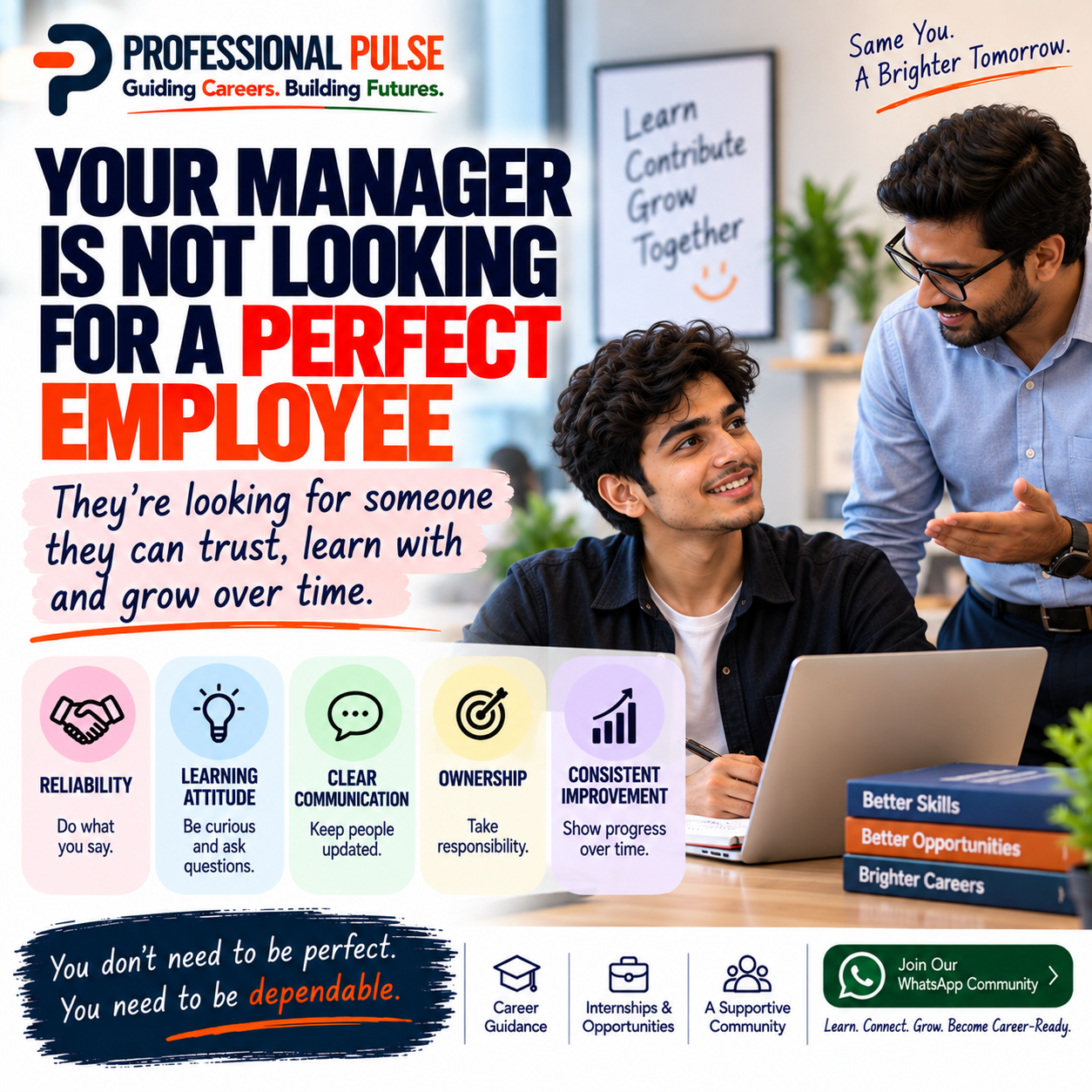
5 Things I’d Look for If I Were Hiring a Fresher

If I were hiring a fresher, I wouldn’t expect them to know everything.

That’s simply not realistic.

You’re starting your career. You’re supposed to have things to learn.

But there are a few things I’d definitely look for.

And interestingly, most of them don’t appear on a marksheet.

1. Can you communicate clearly?

You don’t need perfect English.

You don’t need fancy vocabulary.

But you should be able to explain your thoughts, listen carefully, ask questions, and have a professional conversation.

Good communication isn’t about speaking complicated English.

It’s about making yourself understood.


2. Are you willing to learn?

A fresher who says,

“I don’t know this yet, but I’m willing to learn,”

can sometimes be more valuable than someone who thinks they already know everything.

Your first job will teach you things college couldn’t.

So I’d look for curiosity.

Do you ask questions?

Do you take feedback?

Do you try to improve?

That’s a big signal.


3. Can you solve problems?

I’d probably give you a situation and ask:

“What would you do?”

I’m not necessarily looking for the perfect answer.

I’d be more interested in seeing how you think.

Do you break the problem down?

Do you ask the right questions?

Can you come up with possible solutions?

You don’t need years of experience to demonstrate problem-solving.

You just need to think instead of panic.


4. Have you actually tried doing something?

This is where projects and internships become important.

If your resume says you know digital marketing, coding, Excel, recruitment, design, finance, or anything else—

show me.

Tell me about something you built.

Tell me about an internship.

Tell me about a college project that you actually worked on.

Tell me what went wrong and what you learned.

Experience doesn’t have to mean a full-time job.

Sometimes it simply means you tried.


5. Can I trust you with responsibility?

This one is underrated.

If I give you a task, will you take ownership?

Will you ask when you’re stuck?

Will you meet the deadline?

Will you admit when you’ve made a mistake?

Will you learn from it?

Skills can be developed.

But attitude and ownership can make a huge difference.


Here’s What I Wouldn’t Expect

I wouldn’t expect you to walk into your first interview knowing everything.

I wouldn’t expect a perfect resume.

I wouldn’t expect ten certifications.

And I certainly wouldn’t expect you to have your entire career figured out at 21 or 22.

I’d rather see someone who is curious, prepared, honest and willing to grow.

Because technical skills can be taught.

But the willingness to learn has to come from you.


So, Ask Yourself This

If you had an interview tomorrow, could you confidently answer:

“What can you do?”

“What have you worked on?”

“What did you learn from your mistakes?”

“Why should we give you this opportunity?”

If you’re struggling with these questions, don’t feel bad.

Use them as a starting point.

Your career isn’t built in one interview.

It’s built by preparing for the opportunities before they arrive.


Start Becoming Career-Ready

At Professional Pulse, we help students develop the things that matter beyond a degree—career clarity, practical skills, communication, confidence and real-world experience.

Career Guidance — Find direction before making important career decisions.

Career Readiness Program — Develop practical workplace skills and confidence.

Internship Opportunities — Gain experience and learn by doing.

Join Our WhatsApp Community

Want regular career guidance without having to search for it?

Join the Professional Pulse WhatsApp Community for:

  • Career tips and practical advice
  • Internship and job opportunities
  • Workshops and webinars
  • Skill-building resources
  • Important career updates

Learn. Connect. Grow. Become career-ready.

👉 Join the Professional Pulse WhatsApp Community and start preparing for the opportunities you want.

You don’t have to be the most talented student in the room.

Be the student who is prepared, curious and willing to learn.

That’s a quality employers notice.

And more importantly, it’s a quality that will continue helping you long after you get your first job.

Published

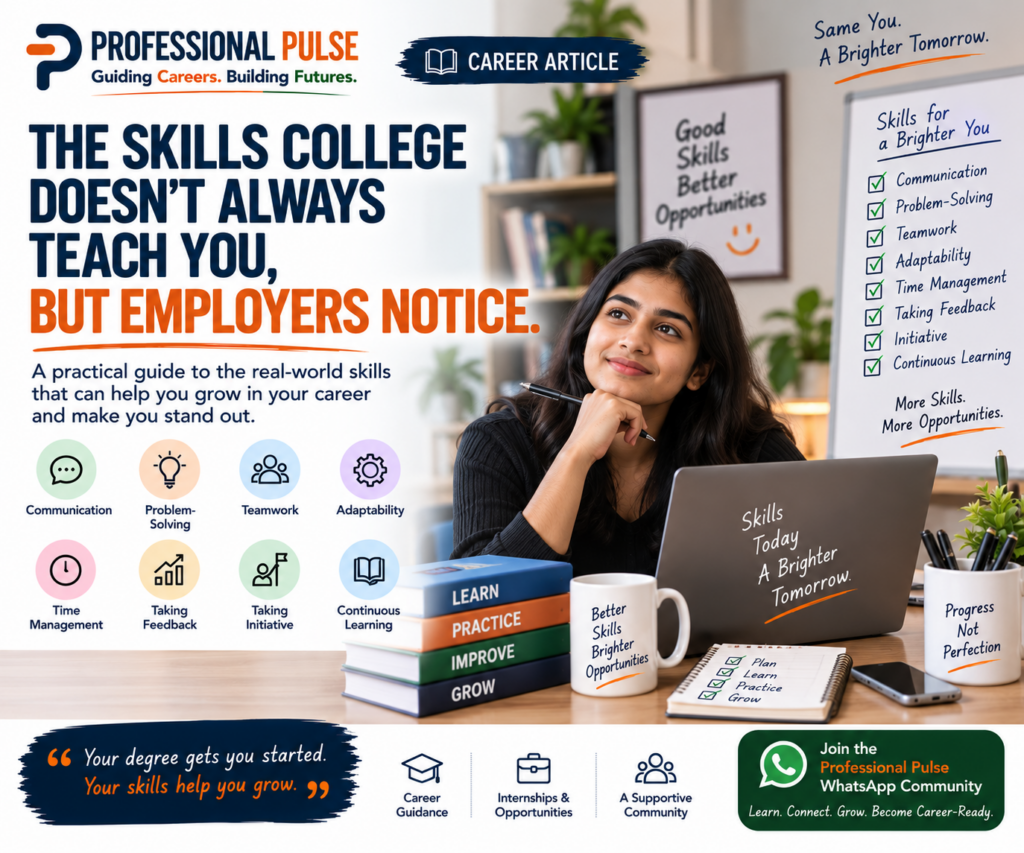
Why Some Students Get Opportunities Faster Than Others

A few months ago, I was talking to two students who were both looking for their first internship.

Both were studying similar courses.

Their academic performance was almost the same.

Both wanted to build a good career.

But their approach was completely different.

One student was waiting for the college placement process.

The other had already started applying to companies, talking to professionals on LinkedIn, working on small projects, and improving his communication.

Neither student was necessarily smarter.

The difference was simple:

One was waiting for an opportunity.

The other was preparing for one.


This Happens More Often Than You Think

Many students spend most of college asking:

“What should I study?”

That’s important.

But there’s another question that doesn’t get asked enough:

“What can I actually do with what I’ve studied?”

Because when you enter the job market, your degree is only one part of the conversation.

An employer may ask:

“Have you worked on a real project?”

“Can you explain what you learned?”

“How would you solve this problem?”

“How comfortable are you communicating with others?”

“What have you done outside your classroom?”

These questions can be difficult if your entire college experience has been about attending classes and preparing for exams.


Marks Matter. But They Aren’t the Whole Story.

I’m not going to tell students that academics don’t matter.

They do.

Good academic performance shows discipline and understanding.

But imagine two candidates with similar marks.

Candidate A has a degree and several certificates.

Candidate B has a degree, one relevant project, an internship, decent communication skills, and can confidently explain what they have learned.

Who has given the employer more reasons to say yes?

That’s the difference between being qualified and being employable.


You Don’t Need to Do Everything.

This is where students sometimes get overwhelmed.

They think they need:

10 certificates.

5 internships.

A perfect LinkedIn profile.

Excellent communication.

Multiple projects.

And somehow a 9+ CGPA.

No.

Start with one thing.

Learn one useful skill.

Then use it.

Build something.

Then show it.

Take an internship.

Learn from the experience.

Talk to someone in the industry.

Repeat.

Small actions compound.


Here’s What I Would Tell Any Student

Don’t wait until your final semester to ask,

“What am I going to do after graduation?”

Start asking that question much earlier.

Not because you need to have your entire life planned.

But because early exploration gives you something incredibly valuable:

time to make mistakes.

You can try a field and realize you don’t like it.

You can learn a skill and decide it’s not for you.

You can attend an interview and perform badly.

You can send a networking message and receive no response.

That’s okay.

You’re learning.

And every experience gives you more information about yourself and the career you want.


So Why Do Some Students Get Opportunities Faster?

Usually, it’s not one magical quality.

They simply start earlier.

They experiment more.

They build relationships.

They gain experience.

They learn from rejection.

And most importantly—

they don’t wait until they feel completely ready.


A Small Challenge

If you’re a student reading this, do one thing this week:

Apply for one opportunity you genuinely want.

Don’t worry about whether you’re perfectly qualified.

Read the requirements.

See where you match.

See where you need to improve.

Then apply.

Because sometimes the first opportunity doesn’t come after you’re ready.

It comes because you were willing to try.

Ready to Start Building Your Career?

If you’re a student wondering where to start, you don’t have to figure everything out alone.

At Professional Pulse, we help students move from “I don’t know what to do” to “I know what I’m working towards.”

Career Guidance — Understand yourself and explore suitable career paths.

Career Readiness Program — Build practical skills, communication, confidence, and workplace readiness.

Internship Opportunities — Gain real-world experience and learn how the workplace actually works.

Want Regular Career Guidance?

Join our Professional Pulse WhatsApp Community where we regularly share:

  • Career guidance and practical tips
  • Internship and job opportunities
  • Career workshops and webinars
  • Skill-building resources
  • Important updates for students

It’s a space for students who want to learn, connect, and become career-ready.

👉 Join the Professional Pulse WhatsApp Community and start building your career with us.

Don’t wait until graduation to become employable. Start building your skills, experience, and confidence today.

Your college years aren’t just preparation for your career.

They are the beginning of your career.

Don’t spend them only collecting marks and certificates.

Use them to discover what you can actually do.

Don’t wait for opportunities. Start becoming ready for them.

Published

If I Were a College Student Again, I’d Do These 5 Things Differently

Sometimes students ask me,

“What should I do during college if I want a good career?”

My answer isn’t complicated.

If I could go back to my college days, I wouldn’t try to do everything.

I’d focus on doing a few things consistently.

Here are the five things I’d start much earlier.


1. I’d build one useful skill outside my syllabus.

College teaches you a lot.

But the workplace often asks for something slightly different.

I’d pick one skill that interests me and spend months getting genuinely good at it.

Not ten certifications.

One skill I could actually use.


2. I’d take internships seriously.

I used to think internships were mainly about adding a line to your resume.

They’re much more than that.

An internship lets you experience deadlines, teamwork, managers, clients, mistakes and responsibility.

You learn things from real work that no classroom can fully teach.

And yes, sometimes you’ll realise:

“This isn’t the career for me.”

That’s useful too.

Better to discover that during college than after graduation.


3. I’d start networking before I needed a job.

This is something many students get wrong.

They start messaging professionals only when placements are around the corner.

I’d start much earlier.

I’d connect with people whose work interests me.

Ask genuine questions.

Listen to their experiences.

Learn how different careers actually work.

Networking isn’t about asking everyone for a job.

It’s about building relationships before you need them.


4. I’d create proof of what I can do.

A resume can say,

“I know Excel.”

“I know digital marketing.”

“I know coding.”

But I’d rather show something.

A project.

A case study.

A portfolio.

A presentation.

A piece of writing.

Something that makes someone say,

“Okay, this person can actually do it.”

That’s powerful.


5. I’d stop worrying so much about having everything figured out.

This might be the biggest one.

At 18, 20 or 22, you’re still learning who you are.

It’s okay if your first plan changes.

It’s okay if you discover a different interest.

It’s okay if someone else seems ahead.

I’d spend less time trying to predict my entire future and more time experimenting with different possibilities.

Because sometimes you don’t find clarity by thinking harder.

You find it by trying things.


If You’re Still in College…

Don’t wait until your final semester to suddenly become “career-ready.”

Start small.

Learn something.

Build something.

Meet someone.

Try something.

Make mistakes.

Then try again.

You don’t need to have your entire career figured out.

You just need to make sure you’re moving forward.


One Question for You

If you could go back to your first year of college, what would you do differently?

I’d genuinely love to hear your answer.

Your experience might help a student who is just starting their journey.

Start Building Before Graduation

At Professional Pulse, we help students develop career clarity, practical skills, confidence and real-world exposure through our Career Guidance, Career Readiness and Internship programs.

Because the goal isn’t simply to graduate.

It’s to graduate ready.

Published

Your Degree Isn’t a Career Plan

A student once told me,

“Sir, I’ll start thinking seriously about my career after I graduate.”

I asked him,

“What are you going to do until then?”

He laughed.

But honestly, this is something I hear quite often.

Students spend years working toward a degree and assume the career part will automatically follow.

Unfortunately, it doesn’t always work that way.

Your degree tells an employer what you studied.

It doesn’t always tell them:

  • What you can actually do.
  • How you solve problems.
  • Whether you can communicate well.
  • Whether you’ve worked on something real.
  • Whether you’re comfortable working with people.
  • Whether you’re ready for a professional environment.

That’s why two students with the same degree can have completely different career outcomes.

One may have spent college only preparing for exams.

The other may have also completed an internship, built projects, learned useful tools, attended industry events, connected with professionals and tried different things.

Their degrees might look similar on paper.

Their experiences won’t.


I’m Not Saying Your Degree Doesn’t Matter.

It absolutely does.

Your education gives you knowledge, a foundation and often access to opportunities.

But think of it this way:

Your degree is the foundation.

Your skills and experiences are what you build on top of it.

You need both.


So What Can You Start Doing?

You don’t need a five-year career plan.

Start small.

Learn one useful skill outside your syllabus.

Take an internship.

Build something you can show people.

Talk to someone working in a field you’re interested in.

Create a LinkedIn profile and start learning how professionals communicate.

Try things.

Some of them won’t work.

That’s okay.

You’re not wasting time.

You’re discovering what you’re good at—and what you actually enjoy.


Here’s a Simple Test

If you graduated tomorrow, could you answer these questions confidently?

“What can you do?”

“What have you worked on?”

“What kind of problems can you solve?”

“Why should we hire you?”

If you’re struggling to answer, don’t panic.

That’s not a failure.

It’s simply a sign that you have some building to do.

And the good news?

You can start today.


One Thing I’d Tell Every Student

Don’t spend three or four years preparing for a career and then start building one in your final semester.

Use your college years to experiment, learn and gain experience.

Because when graduation arrives, you shouldn’t just have a degree in your hand.

You should have something to show for the years you spent earning it.


Start Building Before You Graduate

At Professional Pulse, we help students move beyond academic learning through Career Guidance, Career Readiness, and real-world Internship opportunities.

Because the goal isn’t simply to help you get a degree.

It’s to help you become ready for what comes after it.

Your degree tells people what you studied.

Your skills and experiences show them what you can do.

Published

Three Decisions That Changed My Career More Than Any Degree

When students ask me,

“Sir, what’s the best career decision you’ve made?”

They usually expect me to mention a course, a certification, or a job.

But honestly…

The biggest changes in my career didn’t come from a classroom.

They came from a few simple decisions that completely changed the way I looked at growth.


1. I stopped trying to know everything before I started.

There was a time when I believed I needed to be fully prepared before taking the next step.

Another course.

Another video.

Another week of planning.

The problem?

Preparation slowly turned into procrastination.

The day I decided to start before I felt ready, I learned more in a few weeks than I had in months of overthinking.

Sometimes, action teaches what planning never can.


2. I started saying “yes” to opportunities that scared me.

The opportunities that helped me grow were rarely the comfortable ones.

Speaking in front of people.

Taking responsibility for a new project.

Meeting people I had never spoken to before.

Each experience felt uncomfortable in the beginning.

But every one of them left me more capable than I was before.

Growth usually hides behind the opportunities we almost ignore.


3. I invested in learning, even when no one asked me to.

The world changes quickly.

New tools.

New skills.

New ways of working.

I realized that waiting for someone else to tell me what to learn was a mistake.

The people who stay relevant are the ones who stay curious.

Learning isn’t something you finish after college.

It’s something that becomes part of your life.


If I Could Give One Piece of Advice…

Don’t spend so much time trying to make the perfect career decision.

Instead, make a good decision.

Learn from it.

Adjust if needed.

And keep moving.

Careers aren’t built by people who never make mistakes.

They’re built by people who are willing to learn from every decision they make.


Your Next Step

If you’re still unsure about your career direction, start with clarity.

Career Clarity Workshop – Understand yourself, explore career options, and make informed decisions.

Career Readiness Program – Build practical skills, confidence, and industry-ready experience.

Internship & Job Opportunities – Turn learning into real-world experience.

Your degree opens opportunities.

Your decisions determine where those opportunities take you.

Published

The Biggest Career Mistake Isn’t Choosing the Wrong Path. It’s Never Choosing One.

A student once told me,

“Sir, I’m scared of making the wrong career choice.”

So I asked him a simple question.

“How long have you been thinking about it?”

He smiled and said,

“Almost two years.”

That answer stayed with me.

Not because he was confused.

But because he had spent two years waiting for certainty.


Here’s something I wish every student understood.

There is no career path with a guarantee.

No course that promises success.

No decision that’s completely risk-free.

Every successful professional you admire has made choices without knowing exactly how things would turn out.

The difference is…

They didn’t let uncertainty stop them.


I’ve seen students delay internships because they wanted the “perfect” company.

Postpone learning a skill because they weren’t sure it would be useful.

Avoid applying for opportunities because they thought they needed to be more prepared.

Months passed.

Sometimes years.

Not because they lacked ability.

Because they were waiting for complete confidence before taking action.


The truth is, clarity rarely comes before action.

It usually comes because of action.

You understand your interests by working on projects.

You discover your strengths by solving real problems.

You learn what you enjoy by trying different experiences.

Waiting won’t answer those questions.

Experience will.


If you’re feeling stuck today, don’t ask yourself,

“What’s the perfect career decision?”

Instead ask,

“What’s the next small step I can take?”

Maybe it’s enrolling in a course.

Maybe it’s updating your LinkedIn profile.

Maybe it’s applying for an internship.

Maybe it’s talking to someone already working in the field you’re curious about.

One small step is always more valuable than another month of overthinking.


A Challenge for This Week

Write down one career decision you’ve been postponing.

Now ask yourself:

“Am I waiting because I need more information… or because I’m afraid?”

Your answer might tell you exactly what to do next.

Ready to Make Better Career Decisions?

The best career decisions come from understanding yourself, exploring opportunities, and gaining real experience.

Our Career Clarity Workshop helps students identify the right direction, while the Career Readiness Program equips them with practical skills and confidence to move forward.

Your future won’t be shaped by the perfect decision.

It will be shaped by the decisions you’re brave enough to make.

Published

The Biggest Confidence Killer Isn’t Failure. It’s Comparison.

A student once asked me,

“Sir, why does everyone else seem to be doing better than me?”

I asked him,

“Compared to whom?”

He smiled.

Because he already knew the answer.


He had been comparing himself to people on LinkedIn.

Friends who had landed internships.

Classmates posting offer letters.

People celebrating promotions.


What he couldn’t see was the part of their journey they never posted.

The rejections.

The self-doubt.

The late nights.

The mistakes.


Comparison has a strange way of making us feel behind, even when we’re making progress.

You complete a certification.

Then you see someone who has completed five.

You get your first internship.

Then someone posts about an international internship.

You finally start speaking confidently.

Then you meet someone who seems naturally confident.

And suddenly, your own progress doesn’t feel like progress anymore.


Here’s what I’ve learned after working with students.

The ones who grow the fastest aren’t obsessed with what everyone else is doing.

They’re focused on one question:

“Am I better than I was last month?”

That’s the only comparison that really matters.


If you’re constantly looking sideways, you’ll miss how far you’ve already come.

Instead, pause for a moment.

Think about the version of yourself from a year ago.

Maybe you communicate better now.

Maybe you’ve learned new skills.

Maybe you’ve become more disciplined.

Maybe you’re simply more willing to try.

That’s growth.

Don’t ignore it.


A Small Challenge
Tonight, write down three ways you’ve improved in the last six months.

Not someone else.

Just you.

You’ll realize you’ve made more progress than you give yourself credit for.


Ready to Build Real Confidence?
Confidence doesn’t come from comparing yourself with others.

It comes from learning, practicing, and taking action consistently.

Join our Career Readiness Program and start building the skills—and confidence—that employers truly value.


Stop asking, “Am I better than everyone else?”

Start asking, “Am I better than I was yesterday?”

That’s where real confidence begins.

Published

Drone Programming & Aerial Robotics Career After 12th

Drone Programming & Aerial Robotics Career After 12th

Are you thinking about a Drone Programming & Aerial Robotics Career after class 12th? Drones are no longer just gadgets — they are shaping the future of defense, delivery, farming, and filmmaking. If you love technology and want to work in one of the fastest-growing fields, this career can open exciting opportunities with great scope ahead.


This blog is a complete guide to help you understand drone programming and aerial robotics as a career path, especially after Class 12.

What is Drone Programming & Aerial Robotics?

Drone Programming involves writing software that controls drone behavior, autonomy, path planning, data collection, and AI-based decision-making.

Aerial Robotics refers to robotic systems that operate in the air—typically drones or UAVs—that combine mechanical design, sensors, AI, and embedded systems.

Together, these fields merge software and hardware skills to create intelligent flying machines.

Why Choose This Career After Class 12?

You can start your journey after completing 10+2 in Science (PCM preferred). Some courses are also open to non-science backgrounds for pilot or basic operator roles.

Career Entry Options:

  • Diploma in Drone Technology

  • B.Sc. in Drone Applications

  • B.Tech in Aerospace Engineering or Avionics

  • BCA/ B.Sc. in Robotics + Specialized Drone Certifications

  • Private Drone Programming Bootcamps

Core Skills You’ll Need

  • Python, C++ (Drone firmware, AI navigation)
  • Embedded systems, IoT

  • Computer vision (OpenCV, drone camera processing)

  • Aerodynamics & Flight control systems

  • RTOS (Real-Time Operating Systems)

Foundational Disciplines Behind Drone Technology

Drone programming is not a standalone skill—it’s powered by deep technical fields:

  • Aerospace Engineering: Focuses on aerodynamics, propulsion, and flight mechanics

  • Avionics: Controls navigation systems, autopilot, communication modules

  • Robotics Engineering: Motion planning, AI, mechanical integration

  • Electronics & Embedded Systems: Power systems, microcontrollers, telemetry


For serious R&D roles, consider long-term paths like BTech in Aerospace, Mechatronics, or AI-robotics specializations.

Career Opportunities

the image is showing all career opportunity of drone programming through a table.

Top Courses & Institutions

👨‍🎓 Government & Reputed Institutes:

  • IIT Kanpur – Drone Technology Research Lab

  • Anna University – B.Tech Aerospace (with UAV electives)

  • Amity University – B.Sc. Drone Applications

  • IIAE Dehradun – Aerospace Engineering

📕 Private Certifications:

  • DroneAcharya Aerial Academy

  • IG Drones Skill Academy

  • IIT Roorkee (Drone Programming NPTEL)

Should You Study Aerospace Engineering?

If your goal is to contribute to drone R&D, defense systems, or high-end drone tech like swarm robotics or satellite-linked drones — then Aerospace Engineering is a powerful route. It opens doors to work at:

  • ISRO, DRDO, HAL

  • Aerospace divisions of tech giants

  • UAV-focused startups with strong funding


For tech-driven roles (AI + drone coding), you can also explore CS + robotics combinations with drone electives.

What You’ll Actually Do (Job Scope)

  • Build autonomous flight systems

  • Create obstacle avoidance AI

  • Develop mission-planning software

  • Integrate computer vision for object tracking

  • Program GPS navigation for commercial delivery

What You’ll Actually Do (Job Scope)

Pros:

  • High demand in government and private sectors

  • Cross-domain exposure (AI, IoT, Aero, Robotics)

  • Freelancing and startup potential

Cons:

  • Requires strong technical learning

  • Regulations are still evolving

  • Licenses needed for some roles (DGCA for pilots)

Final Thoughts

Drone technology is no longer just a niche — it’s at the center of the next industrial and digital revolution. Whether you enter via aerospace engineering, drone tech diploma, or robotics + AI route, this is a career that rewards innovation, curiosity, and bold ambition.

Related Reads You’ll Love:

Published

IIT Kanpur 4-Week Python Course for AI Learners | Professional Pulse

Unleash Your AI Potential with the IIT Kanpur Certification Program on Python

Vardan Dubey – November 17, 2024

A boy is doing coding with tea

In today’s tech-driven world, AI, ML, and DL skills are in high demand. Whether you’re a student, professional, or tech enthusiast, mastering these technologies can give you a competitive edge. Learn from one of India’s top institutions, IIT Kanpur, with their 4-week Python course designed to equip you with essential skills for success.

Why Should You Join the IIT Kanpur Certification Program?

The IIT Kanpur Certification Program on Python for AI, ML, and DL is a 4-week, intensive, hands-on training program designed to equip participants with the skills and tools needed to excel in these cutting-edge fields. This program is an exceptional opportunity for anyone looking to develop real-world applications using Python and various high-impact libraries like NumPy, Pandas, Matplotlib, TensorFlow, and more.

Key Features of the Program:

Hands-on Python Projects: Work on practical projects using real-world datasets across various domains, including business, medicine, engineering, and more.

Comprehensive Curriculum: Dive deep into Python programming, AI algorithms, and ML/DL techniques that power the next generation of technology.

Expert Guidance: Learn from IIT Kanpur’s renowned faculty members and industry professionals with decades of experience in AI and ML.

Flexible Learning Schedule: With sessions held on evenings and weekends, this program is designed to fit into your busy schedule—whether you are a student, a working professional, or an academic.

No Prior Experience Required: Whether you are a beginner or an experienced programmer, this program covers everything from the basics of Python to advanced AI/ML concepts.

Who Can Benefit from This Program?

Undergraduate and Postgraduate Students: Get a competitive advantage in your academic projects and thesis, while learning key AI/ML skills that are highly valued by employers.

Class XI and XII Students: Lay a solid foundation for a successful career in tech by mastering Python programming and AI/ML at an early age.

Ph.D. Scholars and Faculty: Enhance your research capabilities with hands-on Python training and AI/ML techniques for cutting-edge research.

Industry Professionals: Upskill in Python and AI/ML, and apply your new knowledge to real-world projects in your current role.

The Python Programming and Packages Covered

A girl is showing Python's logo from aback

Participants will be trained on industry-standard Python libraries and frameworks that are essential for AI, ML, and DL development:

  • NumPy and Pandas for data manipulation and analysis
  • Matplotlib for data visualization
  • Scikit-learn for machine learning algorithms
  • TensorFlow and Keras for deep learning applications

These tools are integral for building powerful models and algorithms that fuel AI innovation across industries.

Learning Outcomes

By the end of this 4-week certification program, participants will:


  • Master Python programming fundamentals and advanced concepts.
  • Gain hands-on experience in AI/ML with real-world data.
  • Be equipped with the skills needed to create and deploy machine learning and deep learning models.
  • Gain practical knowledge to solve problems and prepare for AI/ML job interviews and exams.

How to Register?

Registration for the Python for Artificial Intelligence (AI), Machine Learning (ML), and Deep Learning (DL) certification program is now open! Don’t miss out on the chance to learn from the experts at IIT Kanpur. The program is designed to accommodate both academic and professional participants, so make sure to register soon to secure your spot!

For further details and to register, check out the Registration Page.

Final Thoughts

Whether you are looking to accelerate your career, enhance your research, or learn new skills, this program is your gateway to mastering the most sought-after technologies in the world of AI, Machine Learning, and Deep Learning.

Join the IIT Kanpur Certification Program today and take the first step toward becoming a tech leader in AI/ML

If you have any questions about this course or need guidance on your career path, feel free to reach out to us. We’re here to help!

Name
Published