Professional Pulse

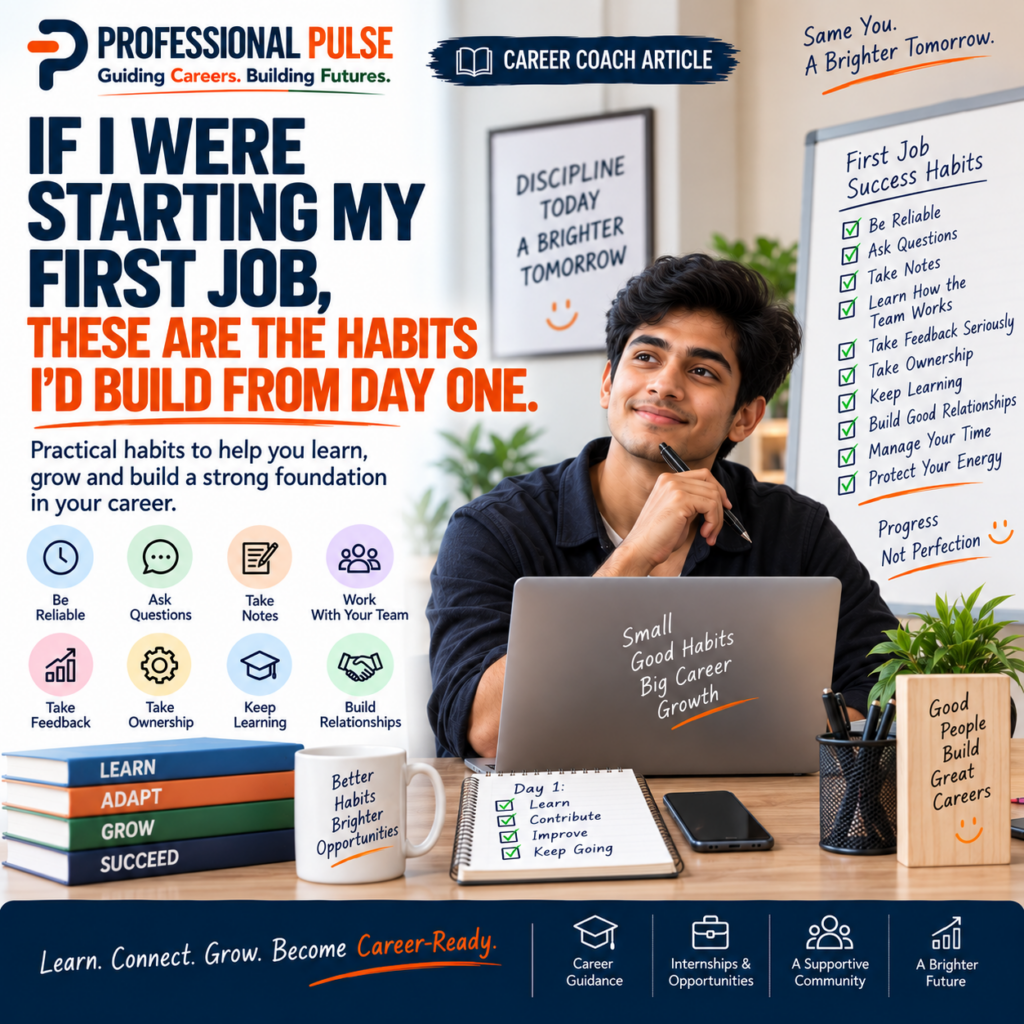
If I Were Starting My First Job, These Are the Habits I’d Build From Day One

Getting your first job is exciting.

You finally have an opportunity to earn, learn, and start building the career you’ve been thinking about for years.

But there’s something I wish more students understood before their first day at work.

Getting selected is one achievement. Learning how to become a good professional is another.

Your first few months at work are not just about completing tasks.

They’re about learning how to work with people, handle responsibility, and build trust.

If I were starting my first job tomorrow, these are the habits I’d focus on.

1. I’d Be Reliable

I wouldn’t try to impress everyone on my first day.

I’d focus on being someone my team could depend on.

That means showing up on time, completing the work I’ve committed to, and communicating if something is going to be delayed.

It sounds simple.

But when a manager knows they can rely on you, it makes a difference.

You don’t have to be the most talented person in the room to become valuable.

Start by being dependable.

2. I’d Ask Questions

When you’re new, you won’t know everything.

You may not understand a process.

You may be unsure about a task.

You may not know how your team prefers to work.

And that’s okay.

I’d rather ask a thoughtful question than spend three hours doing something incorrectly because I was afraid of looking inexperienced.

Before asking, I’d try to understand the problem myself.

Then I’d ask clearly:

“I’ve tried this approach, but I’m stuck here. Could you help me understand what I should do next?”

That’s a much better habit than pretending everything is clear.

3. I’d Take Notes

On my first day, I’d carry a notebook or keep a place to record important things.

Names.

Processes.

Instructions.

Questions.

Feedback.

Things I need to remember.

Because when you’re new, there’s a lot of information coming at you.

You won’t remember everything.

And that’s normal.

Taking notes shows that you’re paying attention and helps you become more independent over time.

4. I’d Learn How My Team Works

Every workplace has its own way of doing things.

Some teams communicate through email.

Others use chat tools.

Some have daily meetings.

Some expect you to share updates at the end of the day.

I’d spend time understanding these expectations instead of assuming that the way I worked in college is automatically the right way to work here.

I’d observe how people communicate, how work is assigned, and how decisions are made.

Not to copy everyone.

But to understand the environment I’m part of.

5. I’d Take Feedback Seriously

This one can be difficult.

Imagine you’ve worked hard on something, and your manager tells you it needs improvement.

Your first reaction might be to defend yourself.

I understand.

But I’d try to pause and listen.

I’d ask:

“What would you like me to improve?”

Then I’d work on it.

You don’t have to agree with every piece of feedback.

But learning how to receive it professionally can help you grow.

Your first job is a place to learn, not a place to prove that you already know everything.

6. I’d Take Ownership of My Work

If I make a mistake, I’d try to acknowledge it and understand how to fix it.

If I finish a task, I’d check whether there’s anything else I need to do.

If I commit to something, I’d follow through.

Taking ownership doesn’t mean doing everything alone.

It means not disappearing when something becomes difficult.

A good professional knows when to solve a problem independently and when to ask for help.

7. I’d Keep Learning Outside My Job Description

Your job will teach you a lot.

But I’d still spend some time improving skills that could help me in the future.

Maybe it’s Excel.

Maybe it’s communication.

Maybe it’s understanding the industry.

Maybe it’s learning a new tool.

Maybe it’s getting better at writing professional emails.

I wouldn’t try to learn everything at once.

I’d choose one useful skill and spend a little time each week developing it.

Because the career you want in three years may require skills you haven’t started building yet.

8. I’d Build Good Relationships

You don’t have to become best friends with everyone at work.

But I’d make an effort to be respectful, helpful, and approachable.

I’d get to know my teammates.

I’d appreciate people who help me.

I’d avoid unnecessary gossip.

And I’d remember that the way I treat people matters.

Your professional reputation isn’t built only through your work.

It’s also built through how people experience working with you.

9. I’d Stop Comparing My Beginning With Someone Else’s Middle

This is something many freshers struggle with.

You join a company and see someone who is already confident, skilled, and comfortable in their role.

Then you start thinking:

“Why am I not like that?”

Remember, they may have years of experience.

You are just starting.

Don’t expect yourself to perform like someone who has already been doing the job for a long time.

Compare yourself with where you were last month.

Are you learning?

Are you improving?

Are you becoming more independent?

That’s what matters.

10. I’d Protect My Energy

Being a good professional doesn’t mean saying yes to everything.

I’d learn to manage my time, take breaks, and communicate when my workload becomes difficult to handle.

I’d also remember that my entire identity doesn’t have to come from my job.

Work matters.

But so do health, family, friendships, and the things that make life meaningful.

Building a career is a long journey.

You don’t need to burn yourself out in the first few months.


A Simple First-Week Checklist

If I were starting a new job, I’d focus on these things during my first week:

  • Understand my role and responsibilities.
  • Learn the team’s basic processes.
  • Save important contact details and resources.
  • Ask questions when I need clarity.
  • Take notes during training and meetings.
  • Complete my first tasks carefully.
  • Ask for feedback on how I’m doing.

You don’t have to master your job in a week.

You just need to begin building good habits.


What If Your First Job Isn’t Perfect?

Let’s be realistic.

Your first job may not be exactly what you imagined.

The work may be challenging.

Your manager may have a different working style.

You may discover that you don’t enjoy a particular responsibility.

That doesn’t mean you’ve made a terrible career decision.

Give yourself time to learn and understand the role.

At the same time, pay attention to how you’re being treated and whether the opportunity is helping you grow.

You can learn from a difficult experience without accepting an unhealthy or disrespectful work environment.

Your first job is important.

But it isn’t your last opportunity.


Start Building Your Career Before Your First Day

At Professional Pulse, we believe career readiness is about more than getting selected.

It’s about helping students become confident, capable, and prepared for the professional world.

We support students through:

Career Guidance​ — Understand your strengths and career direction.

​Career Readiness​ — Build communication, confidence and workplace skills.

​Practical Exposure & Opportunities​ — Gain experiences that help you build and explain your professional journey.

Join the Professional Pulse WhatsApp Community

Stay connected with:

  • Career guidance and practical tips
  • Internship and job opportunities
  • Workshops and webinars
  • Skill-building resources
  • Workplace preparation advice

Learn. Connect. Grow. Become Career-Ready.

Join our WhatsApp Community and keep learning with a community that supports your career journey.

Your first job is not just about what you earn.

It’s also about what you learn, how you grow, and the kind of professional you become.

You don’t need to know everything on day one.

You just need to be willing to learn, take responsibility, and keep improving.

Start small. Build good habits. Earn trust.

And remember:
Your first job is where you begin building the professional you want to become.

Published

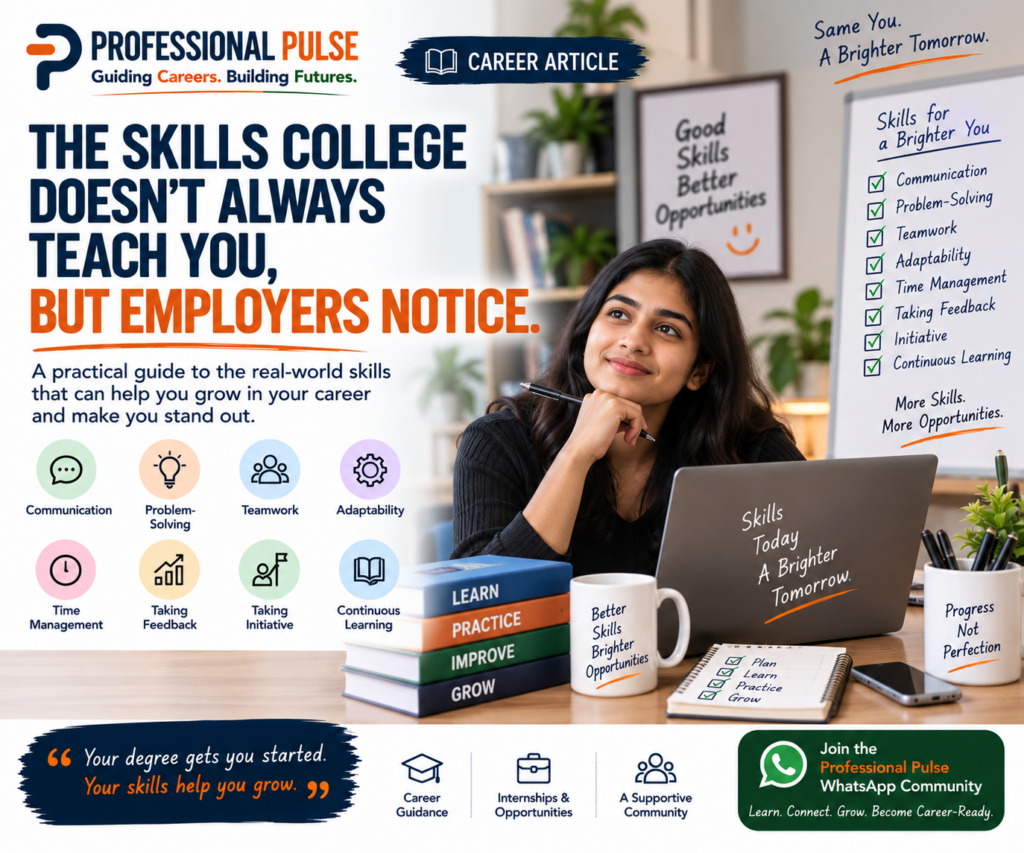
The Skills College Doesn’t Always Teach You, But Employers Notice

I’ve met students with impressive degrees who still feel unsure about starting their careers.

They have good marks. They’ve completed courses. They’ve collected certificates.

But when someone asks them, “What can you actually do?”, they struggle to answer.

And honestly, that’s understandable.

College teaches us many important things. But some of the skills we need at work are learned through practice, experience, and sometimes a few uncomfortable mistakes.

These are the skills that can help you become a better professional.

1. Communication

You may know the answer, but can you explain it clearly?

You may have a good idea, but can you share it with your team?

You may have a problem, but can you ask for help without feeling embarrassed?

Communication isn’t just about speaking fluent English.

It’s about expressing your thoughts, listening to others, and making sure people understand what you’re trying to say.

You can start practicing today.

Explain a project to a friend. Participate in a discussion. Ask a thoughtful question in class.

Small conversations build confidence over time.

2. Problem-Solving

At work, not everything will come with instructions.

Sometimes a customer will have a problem.

Sometimes a deadline will change.

Sometimes the information you need won’t be available.

What will you do then?

You don’t need to know everything immediately.

But you should learn how to break a problem into smaller parts, understand what is happening, and look for a practical solution.

Start with your everyday experiences.

If a college project isn’t going well, don’t just complain about it. Try to understand why and what you can change.

That’s how problem-solving becomes a real skill.

3. Teamwork

A lot of students are comfortable working alone.

But most workplaces require you to work with people who have different personalities, opinions, and ways of doing things.

You won’t always agree with everyone.

You won’t always get your preferred responsibility.

And sometimes, you’ll have to help someone else even when you have your own work to finish.

Learning to cooperate, communicate, and take responsibility for your part of a project is valuable.

Start by becoming someone your teammates can rely on.

4. Adaptability

The skills you learn today may not be enough for every opportunity tomorrow.

New tools will appear. Work processes will change. You may even discover that the career you thought you wanted isn’t the right fit for you.

That doesn’t mean you have failed.

It means you’re learning.

Be willing to explore new things, accept feedback, and improve your approach.

You don’t have to love every change.

But learning how to handle change without giving up is an important part of professional growth.

5. Time Management

You can be talented and still struggle if you regularly miss deadlines.

You can have good ideas and still lose opportunities if you don’t manage your responsibilities.

Time management isn’t about filling every minute of your day.

It’s about understanding what needs to be done, deciding what matters most, and making consistent progress.

Try this simple habit:

At the beginning of each day, write down the three most important things you want to complete.

Start with those.

You don’t need a complicated productivity system to become more organized.

6. Taking Feedback

This is one of the most underrated skills.

Imagine you’ve spent hours working on a project, and someone tells you that it needs improvement.

Your first reaction might be:

“But I worked so hard on it.”

I understand that feeling.

But feedback isn’t always a criticism of you as a person.

Sometimes, it’s simply information that can help you do better.

Learn to ask:

“What can I improve?”

And then actually work on it.

The ability to learn from feedback can help you grow much faster than trying to prove you’re always right.

7. Taking Initiative

You don’t always have to wait for someone to tell you what to do.

If you notice a problem, think about how you could help.

If you want to learn a skill, start exploring it.

If you’re interested in an industry, research it.

If you have an idea for a project, try building a small version of it.

Initiative doesn’t mean doing everything alone or ignoring instructions.

It means being willing to take the first step.

And sometimes, that first step is simply asking a good question.

You Don’t Need to Master Everything

Here’s something I want students to remember.

You don’t need to become excellent at every skill before you graduate.

You also don’t need to compare yourself with someone who already has years of experience.

Choose a few skills that matter for the career you’re exploring.

Practice them.

Look for opportunities to use them.

Then keep improving.

For example, if you’re interested in recruitment, you might start with communication, Excel, candidate research, and interview coordination.

If you’re interested in marketing, you might explore content creation, digital tools, customer research, and communication.

If you’re interested in finance, you might build your Excel, analytical, and financial reporting skills.

The right skills depend on the role.

But the habit of learning and applying what you know is useful in almost every career.

A Simple Challenge for This Week

Choose one skill from this article.

Don’t just save the post and forget about it.

Do something practical.

If you choose communication, record a one-minute introduction about yourself.

If you choose problem-solving, work on a small project and document how you solved a challenge.

If you choose Excel, build a simple budget or data tracker.

If you choose teamwork, volunteer to take responsibility for one part of a group project.

If you choose time management, plan your next seven days.

One small action is better than another week of saying, “I need to improve my skills.”

What Professional Pulse Believes

At Professional Pulse, we believe students deserve more than just a degree.

They deserve guidance to understand their strengths, opportunities to gain practical exposure, and support to become confident professionals.

Whether you’re exploring your career direction, preparing for interviews, or looking for internships, the goal is the same:

To help you become more prepared for the opportunities ahead. We help students become more prepared for the professional world through:

Career Guidance​ — Understand your strengths and career direction.

​Career Readiness​ — Build communication, confidence and workplace skills.

​Practical Exposure & Opportunities​ — Gain experiences that help you build and explain your professional journey.

Join the Professional Pulse WhatsApp Community

Get connected with career guidance, internship and job opportunities, workshops, and practical resources.

Learn. Connect. Grow. Become Career-Ready.

Join our WhatsApp Community and take one more step toward your professional future.

Your degree is important.

Your marks matter.

But don’t underestimate the value of the skills you build along the way.

The ability to communicate, solve problems, work with others, learn from feedback, and take responsibility can make a real difference in your career.

You don’t need to know everything today.

You just need to keep becoming more capable.

Your degree gets you started. Your skills help you grow.

What is one skill you’re going to work on this week?

Published

If I Had an Interview Tomorrow, Here’s Exactly How I Would Prepare

If I had an interview tomorrow, I wouldn’t spend the entire night trying to memorise answers from Google.

I wouldn’t try to prepare for every possible question.

And I definitely wouldn’t copy someone else’s interview answers word for word.

Instead, I would focus on understanding myself, the company, and the role.

Because a good interview isn’t about giving perfect answers.

It’s about being prepared enough to communicate clearly and confidently.

Here’s exactly what I would do.

1. I Would Research the Company

Before attending an interview, I would spend time understanding where I’m applying.

Not for hours.

Even 20–30 minutes of focused research can make a difference.

I would look at:

  • What does the company do?
  • What products or services do they offer?
  • Who are their customers?
  • What industry do they operate in?
  • What have they been doing recently?
  • What does their website or LinkedIn page say about them?

Why?

Because when an interviewer asks:

“What do you know about our company?”

I don’t want my answer to be:

“Honestly, I just applied through a job portal.”

Research shows interest.

And more importantly, it helps you decide whether the opportunity actually interests you.

2. I Would Read the Job Description Again

Many students prepare for an interview without properly understanding the role.

Don’t do that.

Read the job description carefully.

Ask yourself:

  • What will I actually be expected to do?
  • Which skills are important for this role?
  • Which requirements do I already meet?
  • Where do I need to learn more?
  • Which of my experiences connect with this role?

The job description is often giving you clues about what the interviewer may ask.

Use those clues.

3. I Would Prepare My Introduction

I wouldn’t memorise a speech.

I would simply know the important points of my story.

I would prepare:

Where I am now What I’m currently studying or doing.

My relevant background Projects, internships, education or experiences.

What I’ve learned Skills and strengths I’ve developed.

Where I’m going Why I’m interested in this opportunity.

Remember:

Present → Background → Skills → Direction

Practice the structure until it feels natural.

Don’t try to sound impressive.

Try to sound clear.

4. I Would Review Everything on My Resume

This is extremely important.

If something is written on your resume, you should be prepared to talk about it.

Your interviewer may ask about:

  • A project you mentioned
  • A skill you listed
  • An internship
  • A certification
  • An achievement
  • A responsibility

So before the interview, I would read my resume line by line.

Then ask myself:

“If someone asks me about this, can I explain it confidently?”

If the answer is no, either prepare yourself—or reconsider why it’s on your resume.

5. I Would Prepare Real Examples

Students often struggle because they answer everything theoretically.

Instead of only saying:

“I have good problem-solving skills.”

Be ready with an example.

When did you solve a problem?

What was the situation?

What did you do?

What happened?

Your examples can come from:

  • College projects
  • Internships
  • Volunteer work
  • Competitions
  • Team activities
  • Personal projects

You don’t need extraordinary stories.

You need real ones.

6. I Would Practice Common Questions

I wouldn’t try to memorise 100 answers.

But I would practice questions like:

  • Tell me about yourself.
  • Why do you want to work here?
  • Why are you interested in this role?
  • What are your strengths?
  • What is an area you are working to improve?
  • Tell me about a challenge you faced.
  • Where do you see yourself in the future?
  • Why should we hire you?

The goal isn’t to memorise answers.

The goal is to become comfortable thinking and speaking about yourself.

7. I Would Prepare for Questions I Don’t Know

This is where many candidates panic.

They think:

“If I don’t know the answer, the interview is over.”

Not necessarily.

If I genuinely didn’t know something, I wouldn’t pretend.

I might say:

“I’m not completely familiar with that yet, but I would like to learn more about it.”

Or:

“I haven’t worked directly with that, but based on my understanding, I would approach it this way…”

Honesty is better than guessing confidently.

Interviewers don’t expect freshers to know everything.

But they do want to see how you think and how you respond when you’re outside your comfort zone.

8. I Would Prepare Questions for the Interviewer

At the end of an interview, you may hear:

“Do you have any questions for us?”

Please don’t automatically say:

“No, I don’t have any questions.”

Prepare one or two thoughtful questions.

For example:

  • What does success look like in this role during the first few months?
  • What skills are most important for someone joining this team?
  • What does a typical day in this role look like?
  • How does the company support learning and development?

Good questions show curiosity.

And they help you evaluate the opportunity too.

Remember:

You’re not the only person being evaluated.

You’re also learning whether this opportunity is right for you.

My Night-Before Interview Checklist

If my interview were tomorrow, I would make sure I had:

☑ Researched the company

☑ Understood the job description

☑ Prepared my introduction

☑ Reviewed my resume

☑ Prepared examples from my experience

☑ Practiced common questions

☑ Prepared questions for the interviewer

☑ Checked the interview time and location/link

☑ Prepared my clothes and documents

☑ Planned to get enough rest

One important thing:

Don’t sacrifice your sleep trying to prepare until 3 AM.

A tired and anxious mind won’t help you perform better.

Prepare properly.

Then trust your preparation.

And What About Confidence?

Here’s something I want every student to understand.

Confidence doesn’t magically appear on interview day.

It usually comes from preparation.

When you know your story…

When you understand the role…

When you’ve practiced explaining your experiences…

When you’ve prepared for common questions…

You naturally feel more comfortable.

You may still feel nervous.

That’s completely normal.

The goal isn’t to eliminate nervousness.

The goal is to be prepared enough that nervousness doesn’t control you.

Interviews Are a Skill, Not a Personality Trait

Some people believe:

“I’m an introvert, so I’ll never be good at interviews.”

Or:

“I’m not naturally confident.”

But interview skills can be developed.

You can learn to:

  • Communicate clearly
  • Introduce yourself professionally
  • Explain your projects
  • Handle difficult questions
  • Improve body language
  • Think before answering
  • Speak with more confidence

Like any other skill, it improves with practice.

At Professional Pulse, we help students prepare for the professional world through:

Career Guidance — Understand your strengths and career direction.

Career Readiness — Build communication, confidence and workplace skills.

Practical Opportunities — Gain experiences that help you build a stronger professional story.

Join the Professional Pulse WhatsApp Community

Stay connected with:

  • Career guidance and practical tips
  • Internship and job opportunities
  • Workshops and webinars
  • Interview preparation resources
  • Skill-building opportunities

Learn. Connect. Grow. Become career-ready.

👉 Join the Professional Pulse WhatsApp Community and keep preparing for the opportunities ahead.

You don’t need to predict every question.

You don’t need to memorise perfect answers.

You don’t need to pretend you know everything.

Just prepare.

Understand the company.

Understand the role.

Understand your own story.

And practice communicating it.

Good interviews aren’t about giving perfect answers.

They’re about preparation, honesty, and clear communication.

Prepare today.

Your future self will thank you tomorrow.

Published

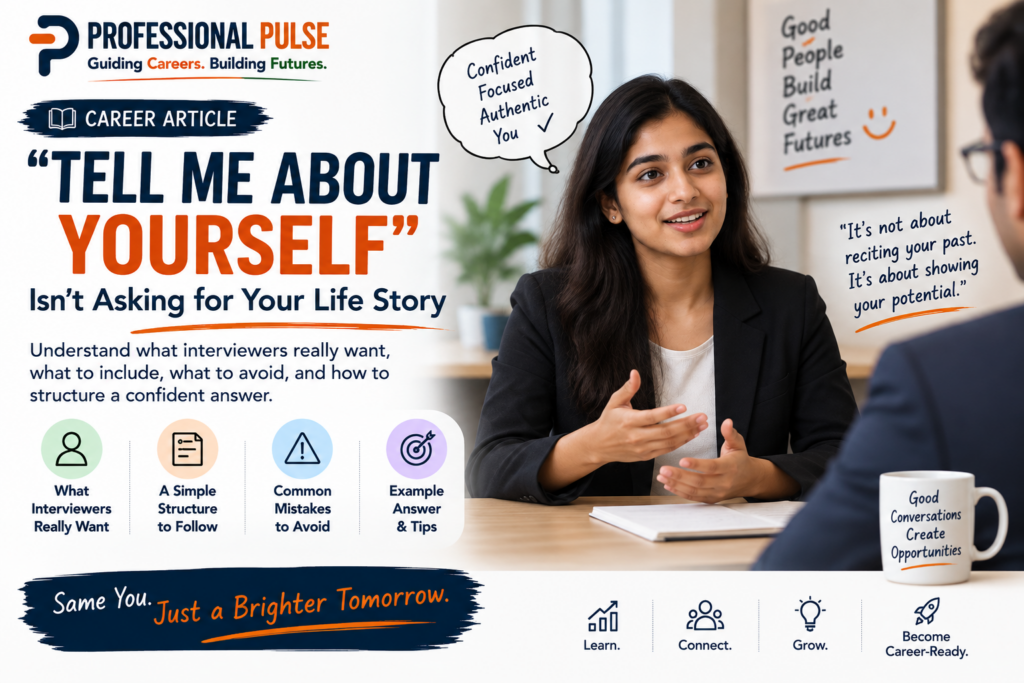
“Tell Me About Yourself” Isn’t Asking for Your Life Story

Almost every student preparing for an interview knows this question is coming.

And still, many panic when they hear it.

“Tell me about yourself.”

Some students start from their childhood.

Some repeat everything written on their resume.

Some talk only about their degree.

And some simply say:

“My name is Rahul. I am from Lucknow. I completed my graduation from XYZ College…”

Then they stop.

The problem isn’t that students don’t have anything to say.

The problem is that they don’t understand what the interviewer is actually asking.

What Does the Interviewer Really Want to Know?

When an interviewer says, “Tell me about yourself,” they usually aren’t asking for your entire biography.

They already have your resume.

What they want is a quick understanding of:

  • Who are you professionally?
  • What is your background?
  • What have you learned or worked on?
  • What are you interested in?
  • Why are you sitting in this interview?

Think of it as your professional introduction.

Not your life story.

A Simple Structure You Can Follow

You don’t need to memories a perfect answer.

But having a structure helps.

1. Start With Your Present

Who are you right now?

For example:

“I’m currently pursuing my MBA with a specialization in Human Resources, and I’ve been actively exploring recruitment and talent acquisition.”

Simple.

You immediately tell the interviewer where you are and what you’re interested in.

2. Briefly Mention Your Background

Talk about relevant education, experience, internships or projects.

For example:

“During my studies, I worked on projects related to employee engagement and also completed an internship where I gained exposure to candidate sourcing and screening.”

You don’t need to explain everything.

Pick the experiences that are relevant to the role.

3. Talk About What You’ve Developed

What skills or strengths have you started building?

For example:

“Through these experiences, I’ve developed my communication and research skills, and I’ve also learned how important, structured processes are in recruitment.”

Notice the difference.

You’re not simply listing skills.

You’re connecting them to your experience.

4. End With Your Direction

Where are you trying to go?

Why are you interested in this opportunity?

For example:

“I’m now looking for an opportunity where I can continue developing my HR skills, gain practical experience, and contribute to a professional team.”

Now the interviewer understands why you’re there.

The Formula Is Simple

Present → Background → Skills/Experience → Direction

That’s it.

You don’t need fancy English.

You don’t need complicated words.

You need clarity.

Here’s a Complete Example

Let’s say you’re a B.Com student applying for a recruitment internship.

You could say:

“I’m currently pursuing my B.Com and have developed a growing interest in recruitment and human resources. During my studies, I’ve worked on team projects and participated in college activities that helped me improve my communication and coordination skills. I’ve also been learning more about recruitment and talent acquisition through online resources and practical exercises. I’m now looking for an opportunity where I can gain hands-on experience, learn from professionals, and start building my career in HR.”

Is this the only correct answer?

No.

And that’s important.

Your answer should sound like you.

Don’t copy someone else’s introduction word for word.

Common Mistakes Students Make

1. Starting With Personal Details

Your name, hometown and family background usually aren’t the most important part of a professional introduction unless the interviewer specifically asks.

Start with where you are professionally.


2. Repeating Your Resume

The interviewer can read your resume.

Use your introduction to connect the important parts of your journey.

3. Giving a Memorized Speech

You can prepare your points.

But don’t memorise every word.

When students memorise answers, they often sound unnatural.

And if they forget one sentence, they panic.

Understand your story instead.

Then explain it naturally.

4. Talking for Too Long

Your answer doesn’t need to be five minutes long.

For most fresher interviews, 60–90 seconds is usually enough to give a clear introduction, unless the interviewer asks follow-up questions.

Be concise.

You can always share more later.

5. Forgetting Why You’re Here

Your introduction should eventually connect to the opportunity.

Don’t just tell the interviewer who you are.

Help them understand:

Why this role makes sense for you.

Practice This Before Your Next Interview

Open your phone and record yourself answering:

“Tell me about yourself.”

Then listen to it.

Ask yourself:

  • Do I sound natural?
  • Am I clear about what I’m interested in?
  • Did I mention relevant experience?
  • Did I explain what I’m looking for?
  • Am I talking for too long?

You might feel awkward watching yourself.

That’s normal.

But the more you practice, the more natural it becomes.

Interviews Are a Skill You Can Practice

Many students think some people are simply “naturally good” at interviews.

That’s not always true.

Some people have simply practiced more.

They’ve learned how to:

  • Introduce themselves clearly
  • Explain their projects
  • Handle difficult questions
  • Communicate under pressure
  • Think before answering

These are skills.

And skills can improve with practice.

At Professional Pulse, we help students become more prepared for the professional world through:

Career Guidance — Understand your strengths and career direction.

Career Readiness — Build communication, confidence and workplace skills.

Practical Exposure & Opportunities — Gain experiences that help you build and explain your professional journey.

Join the Professional Pulse WhatsApp Community

Stay connected with:

  • Career guidance and practical tips
  • Internship and job opportunities
  • Workshops and webinars
  • Interview and career preparation resources
  • Important career updates

Learn. Connect. Grow. Become career-ready.

👉 Join the Professional Pulse WhatsApp Community and keep preparing for the opportunities ahead.

“Tell me about yourself” isn’t a test of how much you can talk.

It’s an opportunity to help someone understand your story.

So don’t memorise someone else’s answer.

Take a few minutes and think about your own:

Where are you now?

What have you learned or worked on?

What can you do?

Where do you want to go next?

When you know those answers, introducing yourself becomes much easier.

Your story doesn’t have to be extraordinary.

It just needs to be clear, honest, and yours.

Published

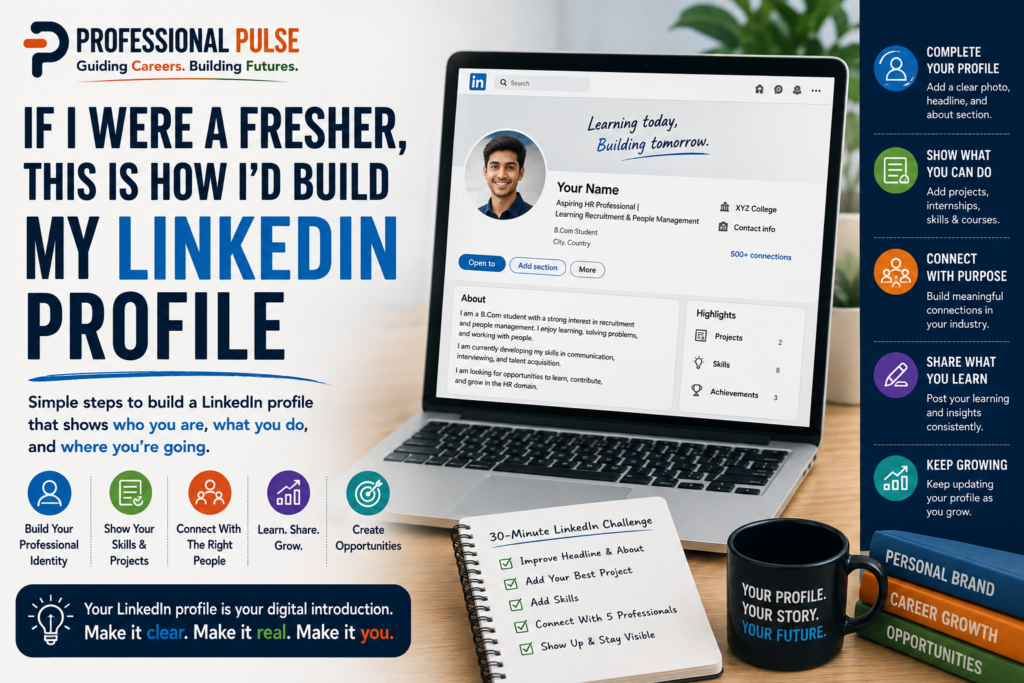
If I Were a Fresher, This Is How I’d Build My LinkedIn Profile

If I were a college student today, I would not wait until graduation to create my LinkedIn profile.

I would start now.

Not because I expect a recruiter to magically find me tomorrow.

But because professional visibility takes time to build.

And honestly, most students make LinkedIn much more complicated than it needs to be.

You don’t need thousands of connections.

You don’t need to post every day.

And you definitely don’t need to pretend you’re an expert.

You just need to make it easy for someone to understand who you are, what you’re interested in, and what you’re working toward.

Here’s how I’d do it.

1. I’d Start With a Clear Headline

I wouldn’t simply write:

“Student at XYZ College.”

That tells people where you study.

It doesn’t tell them much about you.

Instead, I’d use the headline to communicate my direction.

For example:

B.Com Student | Aspiring HR Professional | Learning Recruitment & Talent Acquisition

Or:

Marketing Student | Interested in Digital Marketing | Content & Social Media Learner

It doesn’t have to sound impressive.

It needs to be clear and honest.

2. I’d Write an About Section That Sounds Like Me

I’d avoid copying some complicated paragraph from the internet.

I’d simply answer four questions:

Who am I?

What am I interested in?

What am I currently learning?

What kind of opportunities am I looking for?

For example:

I’m a B.Com student interested in recruitment and people management. I’m currently developing my communication and recruitment skills and looking for opportunities where I can gain practical experience and learn from professionals.

Simple.

Clear.

Human.

That’s enough to start.

3. I’d Add Projects—Even College Projects

This is something students often overlook.

If you’ve worked on a meaningful college project, don’t hide it.

Explain:

What was the project?

What did you do?

What did you learn?

If possible, include the outcome.

For example, instead of:

“Marketing project.”

Write something like:

“Worked on a college marketing project where I developed a social media strategy, researched the target audience, and presented recommendations to improve engagement.”

Now I know what you actually did.

4. I’d Add Skills I Can Actually Defend

Don’t add 30 skills because LinkedIn allows you to.

Choose skills that are relevant to the direction you’re exploring.

And more importantly—

be prepared to demonstrate them.

If you say you know Excel, be ready to use Excel.

If you say you know Canva, have something you’ve designed.

If you say you’re good at communication, be able to communicate.

Your LinkedIn profile should reflect reality.

Don’t build a profile that looks better than you actually are.

Build one that shows where you’re going.

5. I’d Start Connecting With People Before I Needed Something

This is probably the biggest mistake students make.

They create LinkedIn only when they need an internship.

Then they send connection requests to 100 recruiters.

I wouldn’t do that.

I’d start much earlier.

I’d connect with:

  • Alumni
  • Professionals in my field
  • Recruiters
  • People working in companies I admire
  • Other students building interesting careers

And I’d actually pay attention to what these people share.

Because LinkedIn isn’t only a place to ask for opportunities.

It’s a place to learn how the professional world works.

6. I’d Share What I’m Learning

This doesn’t mean becoming a “LinkedIn influencer.”

You don’t have to post motivational quotes every day.

Instead, occasionally share something useful you’ve learned.

For example:

“I recently learned how structured interviews are used in recruitment. One thing I found interesting was…”

Or:

“I completed my first Excel project this week. I struggled with ___, but I learned ___.”

Or simply share an interesting lesson from an internship or workshop.

You aren’t trying to prove that you’re an expert.

You’re showing that you’re learning and taking your development seriously.

7. I’d Keep Improving the Profile

Your LinkedIn profile isn’t a one-time assignment.

As you gain experience, update it.

Completed an internship?

Add it.

Finished a meaningful project?

Add it.

Learned a new skill?

Add it.

Won a competition?

Add it.

Changed your career direction?

Update your profile.

Think of your LinkedIn profile as your professional journey in progress.

It should grow as you grow.

One Thing I Wouldn’t Do

I wouldn’t try to look more experienced than I actually am.

If I’m a fresher, I’m a fresher.

And that’s okay.

I’d rather communicate:

“I’m learning, I’m curious, and I’m actively building my skills.”

than pretend:

“I’m an expert in everything.”

Employers know you’re starting out.

What they want to see is whether you’re serious about developing yourself.

Your 30-Minute LinkedIn Challenge

If you’re a student reading this, open LinkedIn after reading this article.

Set a timer for 30 minutes.

First 10 minutes:

Improve your headline and About section.

Next 10 minutes:

Add your best project, internship, achievement, or experience.

Final 10 minutes:

Find five professionals in your area of interest and connect with them thoughtfully.

That’s it.

Don’t try to build the perfect profile today.

Just make it better than it was yesterday.

Want Help Becoming Career-Ready?

At Professional Pulse, we help students build more than a degree.

Career Guidance — Understand your strengths and explore suitable career paths.

Career Readiness — Build practical skills, communication, confidence and workplace readiness.

Internship Opportunities — Gain real-world experience and build evidence of what you can do.

Join the Professional Pulse WhatsApp Community

We regularly share:

  • Internship & job opportunities
  • Career guidance and practical tips
  • Workshops and webinars
  • Skill-building resources
  • Career updates and opportunities

Learn. Connect. Grow. Become career-ready.

👉 Join the Professional Pulse WhatsApp Community and stay connected with opportunities that can help you move forward.

One Last Thought

You don’t need a perfect LinkedIn profile.

You need an honest, useful and evolving one.

Because when the right opportunity comes along, you want the person looking at your profile to understand:

Who you are.

What you’re interested in.

What you’ve already tried.

And most importantly—

What you’re capable of becoming.

Published

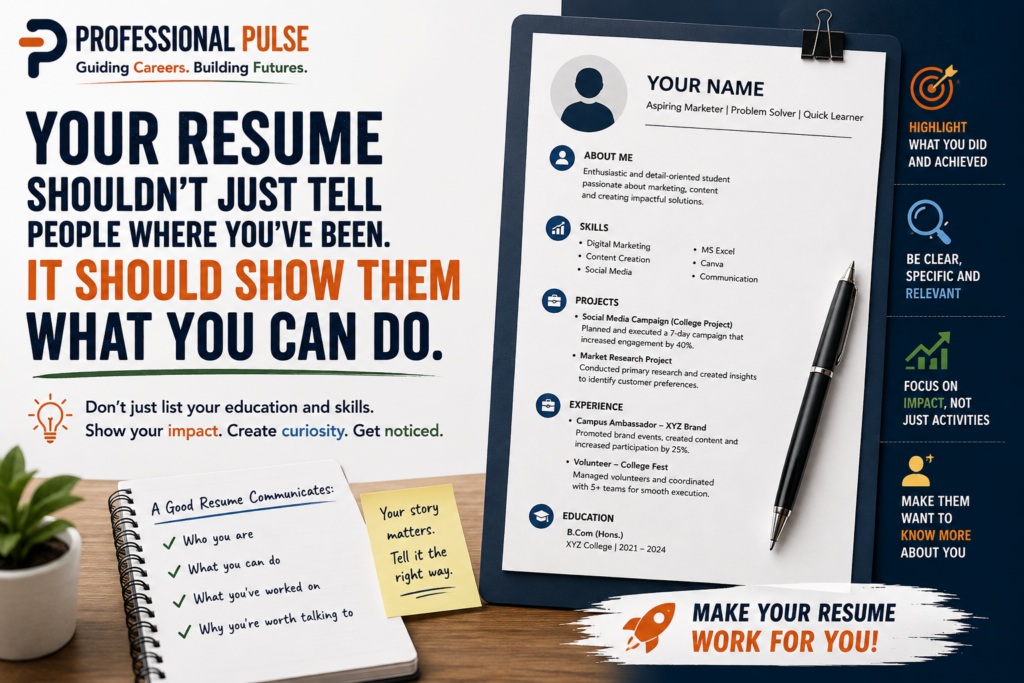
Your Resume Shouldn’t Just Tell People Where You’ve Been. It Should Show Them What You Can Do.

I’ve seen a lot of fresher resumes.

And many of them look almost identical.

Name. Degree. College. Marks. Certificates. Skills.

Then the student wonders:

“Why am I not getting interview calls?”

Sometimes, the problem isn’t that you don’t have anything to offer.

The problem is that your resume doesn’t make it obvious.

Your Resume Has a Very Short Job

Think about what happens when a recruiter receives hundreds of applications.

They don’t know you.

They don’t know how hard you worked.

They don’t know how much potential you have.

All they have is your resume.

So your resume has one important job:

Make the recruiter want to know more about you.

It doesn’t need to tell your entire life story.

It needs to quickly answer:

Who are you?

What can you do?

What have you actually worked on?

Why might you be worth talking to?

“But I Don’t Have Any Experience.”

This is probably the most common thing I hear from students.

And sometimes I ask:

“What have you done during college?”

Then the answers start coming.

“I worked on a marketing project.”

“I helped organize our college fest.”

“I managed social media for our student club.”

“I built a website for a college project.”

“I volunteered at an event.”

“I helped my family business with Excel.”

That’s experience.

Maybe it isn’t formal employment yet.

But you’ve done something.

And that’s what your resume should communicate.

Don’t Just Write What You Did. Explain What You Contributed.

Here’s a simple difference.

Instead of:

“Worked on a college marketing project.”

Try:

“Developed a social media campaign for a college project and analyzed engagement across different content formats.”

The second version gives me something to understand.

What did you work on?

What did you actually do?

What did you learn?

Whenever possible, show the action and outcome.

You don’t need to invent impressive numbers.

Just be specific and honest.

Certificates Aren’t the Whole Story

Certificates can be useful.

But a resume filled with certificates doesn’t automatically demonstrate capability.

If you’ve completed a digital marketing course, tell me what you did with that knowledge.

If you’ve learned Excel, show me a project.

If you’ve learned coding, show me something you’ve built.

If you’ve studied recruitment, tell me about a practical project or experience.

Learning is good.

Applying what you learned is better.

Your Resume and LinkedIn Should Tell the Same Story

Here’s another mistake students make.

Their resume says they’re interested in marketing.

Their LinkedIn says they’re looking for finance opportunities.

Their projects show something completely different.

It’s confusing.

Your professional presence doesn’t need to be perfect.

But it should be consistent.

If you’re interested in a particular field, start building evidence around it.

Learn.

Create.

Share.

Connect.

Gradually, people should be able to understand what you’re working toward.

And Please Don’t Lie

This is important.

Don’t add skills you can’t actually use.

Don’t invent internships.

Don’t exaggerate projects.

Don’t copy someone else’s resume.

You may get past the first screening.

But eventually, someone will ask you about it.

And then you’ll have to explain something you never actually did.

A simple, honest resume is much stronger than an impressive-looking fake one.

A Simple Resume Test

Before sending your resume, give it to someone who doesn’t know you well.

Give them 30 seconds.

Then ask:

“What do you think I can do?”

If they can’t answer, your resume probably needs more clarity.

Your goal isn’t to make your resume complicated.

It’s to make your value easy to understand.

If You’re a Fresher, Start Building Your Resume Now

Don’t wait until placement season.

Start collecting your experiences.

Keep track of:

  • Projects you’ve completed
  • Skills you’ve actually used
  • Internships
  • Volunteer work
  • Competitions
  • Leadership responsibilities
  • Freelance work
  • Relevant achievements

You don’t need to wait until graduation to start building your professional story.

Start documenting it while you’re living it.

Ready to Become More Career-Ready?

At Professional Pulse, we help students go beyond simply earning a degree.

Career Guidance — Explore your strengths and find a direction that makes sense for you.

Career Readiness Program — Build practical skills, communication, confidence and workplace readiness.

Internship Opportunities — Gain real-world experience and create something meaningful to add to your professional story.

Join the Professional Pulse WhatsApp Community

Want regular career guidance and opportunities?

Our WhatsApp Community shares:

  • Internship & job opportunities
  • Career tips and practical advice
  • Workshops and webinars
  • Skill-building resources
  • Important career updates

Learn. Connect. Grow. Become career-ready.

👉 Join the Professional Pulse WhatsApp Community and start building your professional journey today.

Your resume isn’t supposed to prove that you’re perfect.

It’s supposed to make someone curious enough to meet you.

So don’t ask:

“How can I make my resume look impressive?”

Ask:

“How can I make my real abilities easier to see?”

That’s a much better place to start.

Published

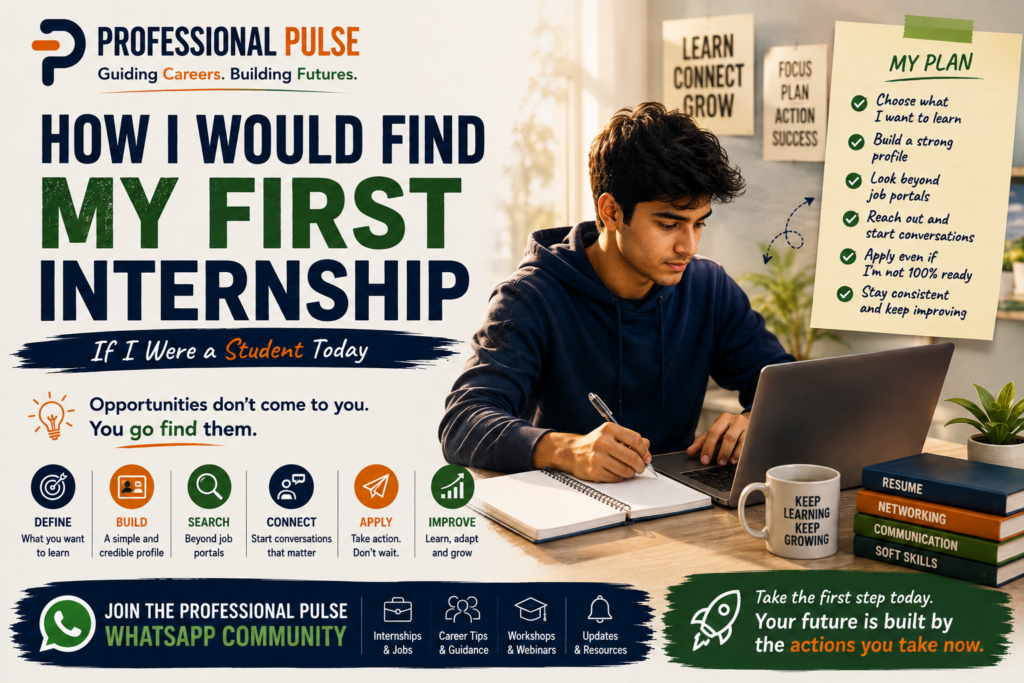
How I Would Find My First Internship If I Were a Student Today

If I were a student today and wanted my first internship, I wouldn’t start by applying to 100 random companies.

I’d start with one simple question:

What kind of experience do I actually want?

Because applying everywhere without direction can quickly become frustrating.

You send applications.

You wait.

You get no response.

Then you start thinking:

“Maybe there are no opportunities.”

But sometimes, the problem isn’t the lack of opportunities.

It’s the approach.

Here is what I would do differently.

1. I Would Choose What I Want to Learn

I wouldn’t search only for the word “internship.”

I’d first decide what I wanted exposure to.

For example:

  • Marketing
  • Recruitment
  • Sales
  • Finance
  • Data analysis
  • Design
  • Operations

I wouldn’t worry about finding the perfect career immediately.

I’d simply choose an area I was curious about and start exploring.

Your first internship doesn’t have to decide your entire future.

Sometimes, it helps you discover what you don’t want to do.

And that’s valuable too.

2. I Would Build a Simple, Honest Profile

Before applying, I’d make sure someone visiting my LinkedIn profile or reading my resume could quickly understand:

Who am I? What am I interested in? What skills am I developing? What have I worked on?

You don’t need to pretend to be an expert.

You’re a student.

It’s okay to say you’re learning.

But don’t leave your profile empty either.

If you’ve completed a project, mention it.

If you’ve learned a useful skill, show how you’ve used it.

If you’ve volunteered or worked on a college initiative, include it.

Your profile doesn’t need to look impressive. It needs to feel credible.

3. I Would Look Beyond Job Portals

Job portals are useful.

But I wouldn’t depend only on them.

I’d also look at:

  • LinkedIn
  • Company career pages
  • Startup communities
  • Professional communities
  • College and alumni networks
  • Small businesses and growing startups

Many students only apply when they see a formal job post.

But smaller companies sometimes need help before they even create an official internship listing.

That’s where a thoughtful message can make a difference.

4. I Would Reach Out, Not Just Apply

This is something I wish more students understood.

Applying is important.

But sometimes, starting a conversation is equally important.

Instead of sending:

“Hello Sir, do you have an internship for me?”

I’d do some research first.

I’d understand what the company does.

Then I’d send a short and genuine message.

Something like:

Hi [Name], I’m currently a student interested in learning more about [field]. I’ve been following the work your company is doing in [specific area], and I’d love to understand how someone starting out can gain practical experience in this field.

No pressure.

No long message.

Just a genuine conversation.

Sometimes, that conversation may lead nowhere.

But sometimes, it can lead to advice, a connection—or even an opportunity.

5. I Would Apply Even If I Didn’t Feel 100% Ready

This one is important.

As a student, you will rarely feel completely ready.

If you wait until you have every skill listed in the job description, you may wait forever.

Instead, I’d ask myself:

Do I understand the role? Do I have some relevant skills or interest? Am I willing to learn what I don’t know?

If the answer is yes, I’d apply.

The company can decide whether I’m a fit.

I don’t need to reject myself before they get the chance to decide.

6. I Would Set a Weekly Target

Finding your first opportunity shouldn’t depend on one application.

I’d create a simple weekly routine:

  • Find 10 relevant opportunities or companies.
  • Apply to 3–5 suitable roles.
  • Connect with 5 people working in my area of interest.
  • Send 2 thoughtful outreach messages.
  • Improve one thing in my profile based on what I learn.

Not hundreds of applications.

Just consistent action.

Because the goal isn’t to look busy.

The goal is to improve your chances every week.

And If I Got Rejected?

Honestly, I’d probably feel disappointed.

Rejection doesn’t suddenly become enjoyable just because someone tells you to “learn from it.”

But I wouldn’t stop there.

I’d ask:

  • Was my profile relevant?
  • Did I have the skills they were looking for?
  • Could I communicate my experience better?
  • What can I improve before the next application?

Every rejection doesn’t mean you’re incapable.

Sometimes, it simply means:

Not yet. Not this role. Or not this approach.

Keep learning and keep improving.

Your First Internship Is About More Than Experience

Your first internship may teach you what kind of work you enjoy.

Or what kind of manager you want to work with.

Or which skills you need to improve.

It may even help you realise that the career you imagined isn’t the one you want.

All of that is useful.

So don’t wait for the perfect internship.

Start looking for the next opportunity to learn.

Because careers rarely move in a straight line.

They grow through conversations, experiments, mistakes, connections and opportunities you were brave enough to pursue.

Start Your Career Journey with Professional Pulse

At Professional Pulse, we help students take practical steps toward their future through:

Career Guidance — Understand your strengths and explore suitable career paths.

Career Readiness — Build practical skills, confidence and workplace readiness.

Internship Opportunities — Gain real-world exposure and learn by doing.

Join the Professional Pulse WhatsApp Community

Want regular access to career guidance and opportunities?

Join our Professional Pulse WhatsApp Community, where we share:

  • Internship and job opportunities
  • Career guidance and practical tips
  • Workshops and webinars
  • Skill-building resources
  • Important career updates

Learn. Connect. Grow. Become career-ready.

👉 Join the Professional Pulse WhatsApp Community and take your first step towards your future.

You don’t need to know exactly where your career will take you.

You just need to be willing to take the next step.

Search. Connect. Apply. Learn. Repeat.

Because your first opportunity may not come from waiting.

It may come from the message you finally send, the application you finally submit, or the conversation you finally start.

Don’t wait for opportunities to find you. Start looking for them.

Published

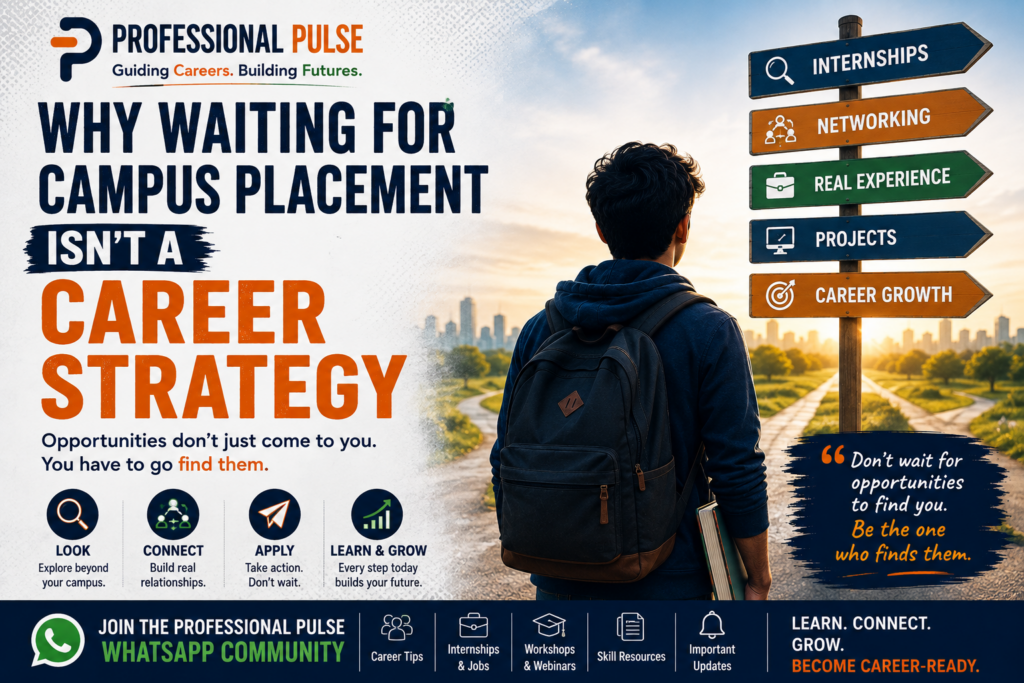
Why Waiting for Campus Placement Isn’t a Career Strategy

For many students, the career plan looks something like this:

Study → Graduate → Sit for campus placement → Get a job.

And honestly, there is nothing wrong with campus placement.

If your college brings good companies and you get selected, that’s great.

But here’s the problem:

What happens if it doesn’t work out?

I’ve spoken to many students who spend their entire college life waiting for placement season. They focus on classes and exams, and only start thinking seriously about their career in the final semester.

Then placement season arrives.

Some students get selected.

Some don’t.

And suddenly, the students who didn’t get selected are left asking:

“What do I do now?”

That’s why I don’t think waiting for campus placement should be your entire career strategy.

Campus Placement Is an Opportunity, Not the Only Opportunity

Your college can help you access companies.

But opportunities also exist outside your campus.

You can:

  • Apply for internships directly.
  • Search for opportunities on LinkedIn and job platforms.
  • Reach out to startups and small companies.
  • Connect with professionals working in your field.
  • Participate in projects, competitions, workshops and communities.
  • Ask people in your network about opportunities.

The important thing is to stop thinking that opportunities only come when someone officially announces them.

Sometimes, you have to go looking for them.

“But I Don’t Have Enough Experience”

This is where many students get stuck.

They see an internship requirement and think:

“They want experience, but I need an internship to get experience.”

It can feel frustrating.

But remember, experience doesn’t only mean having a previous job.

A project can be experience.

Volunteering can be experience.

Helping a small business can be experience.

Working on a college initiative can be experience.

Even learning a skill and using it to solve a real problem gives you something to talk about.

The goal is to start building evidence that you can do something, not just study something.

Start Using LinkedIn Before You Need a Job

One mistake I see students make is creating a LinkedIn profile only when they urgently need a job.

By then, they expect immediate results.

A better approach is to start earlier.

Follow companies you’re interested in.

Connect with professionals whose work you want to understand.

Read about their career journeys.

Engage with useful content.

Ask thoughtful questions.

Share what you’re learning.

You don’t need to message everyone asking for a job.

Start by learning and building genuine professional connections.

That way, when you’re eventually looking for an internship or job, you’re not starting from zero.

You Don’t Need to Match Every Requirement

Another reason students don’t apply is because they think they need to meet 100% of the requirements.

You probably won’t.

Especially when you’re just starting.

Read the opportunity carefully.

Understand what the company is looking for.

If you meet a reasonable number of requirements and believe you can learn the rest, apply.

The company may say no.

But they may also give you an interview.

And even if you don’t get selected, the process can teach you what you need to improve.

Rejection is feedback if you’re willing to learn from it.

The Best Time to Start Looking Is Before You Desperately Need Something

Don’t wait until graduation to start searching for opportunities.

Don’t wait until you’re completely confident.

Don’t wait until your resume looks perfect.

Start exploring now.

Apply for internships.

Talk to people.

Build projects.

Attend workshops.

Join communities.

Learn how to introduce yourself.

Get rejected occasionally.

Improve.

Try again.

Your first opportunity may not come from one perfect application.

It may come after several attempts, conversations and lessons.

A Simple Challenge for This Week

Do these three things:

1. Find five companies where you would genuinely like to learn or work.

2. Follow them and study what they do.

3. Apply or reach out for at least one relevant opportunity.

That’s it.

Don’t overthink the result.

Just take the first step.

Don’t Navigate Your Career Alone

At Professional Pulse, we help students move from confusion to action through:

Career Guidance — Explore suitable career paths and make better decisions.

Career Readiness — Build practical skills, communication, confidence and workplace readiness.

Internship Opportunities — Gain practical exposure and learn by doing.

Join the Professional Pulse WhatsApp Community

Want regular career guidance and opportunities in one place?

Join our Professional Pulse WhatsApp Community for:

  • Career guidance and practical tips
  • Internship and job opportunities
  • Workshops and webinars
  • Skill-building resources
  • Important career updates

Learn. Connect. Grow. Become career-ready.

👉 Join our WhatsApp Community and take an active step toward building your future.

Campus placement can be a great opportunity.

But your career shouldn’t depend on waiting for one opportunity to arrive.

Look beyond your campus. Build connections. Apply. Learn. Try again.

Don’t wait for opportunities to find you. Learn how to find—and create—them.

Published

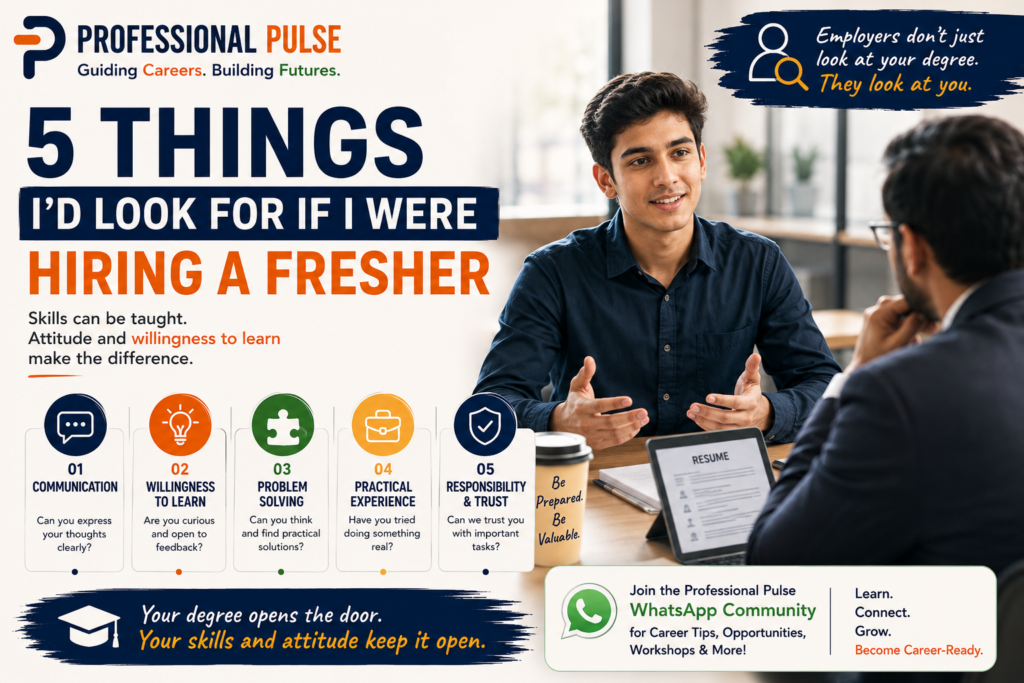
5 Things I’d Look for If I Were Hiring a Fresher

If I were hiring a fresher, I wouldn’t expect them to know everything.

That’s simply not realistic.

You’re starting your career. You’re supposed to have things to learn.

But there are a few things I’d definitely look for.

And interestingly, most of them don’t appear on a marksheet.

1. Can you communicate clearly?

You don’t need perfect English.

You don’t need fancy vocabulary.

But you should be able to explain your thoughts, listen carefully, ask questions, and have a professional conversation.

Good communication isn’t about speaking complicated English.

It’s about making yourself understood.


2. Are you willing to learn?

A fresher who says,

“I don’t know this yet, but I’m willing to learn,”

can sometimes be more valuable than someone who thinks they already know everything.

Your first job will teach you things college couldn’t.

So I’d look for curiosity.

Do you ask questions?

Do you take feedback?

Do you try to improve?

That’s a big signal.


3. Can you solve problems?

I’d probably give you a situation and ask:

“What would you do?”

I’m not necessarily looking for the perfect answer.

I’d be more interested in seeing how you think.

Do you break the problem down?

Do you ask the right questions?

Can you come up with possible solutions?

You don’t need years of experience to demonstrate problem-solving.

You just need to think instead of panic.


4. Have you actually tried doing something?

This is where projects and internships become important.

If your resume says you know digital marketing, coding, Excel, recruitment, design, finance, or anything else—

show me.

Tell me about something you built.

Tell me about an internship.

Tell me about a college project that you actually worked on.

Tell me what went wrong and what you learned.

Experience doesn’t have to mean a full-time job.

Sometimes it simply means you tried.


5. Can I trust you with responsibility?

This one is underrated.

If I give you a task, will you take ownership?

Will you ask when you’re stuck?

Will you meet the deadline?

Will you admit when you’ve made a mistake?

Will you learn from it?

Skills can be developed.

But attitude and ownership can make a huge difference.


Here’s What I Wouldn’t Expect

I wouldn’t expect you to walk into your first interview knowing everything.

I wouldn’t expect a perfect resume.

I wouldn’t expect ten certifications.

And I certainly wouldn’t expect you to have your entire career figured out at 21 or 22.

I’d rather see someone who is curious, prepared, honest and willing to grow.

Because technical skills can be taught.

But the willingness to learn has to come from you.


So, Ask Yourself This

If you had an interview tomorrow, could you confidently answer:

“What can you do?”

“What have you worked on?”

“What did you learn from your mistakes?”

“Why should we give you this opportunity?”

If you’re struggling with these questions, don’t feel bad.

Use them as a starting point.

Your career isn’t built in one interview.

It’s built by preparing for the opportunities before they arrive.


Start Becoming Career-Ready

At Professional Pulse, we help students develop the things that matter beyond a degree—career clarity, practical skills, communication, confidence and real-world experience.

Career Guidance — Find direction before making important career decisions.

Career Readiness Program — Develop practical workplace skills and confidence.

Internship Opportunities — Gain experience and learn by doing.

Join Our WhatsApp Community

Want regular career guidance without having to search for it?

Join the Professional Pulse WhatsApp Community for:

  • Career tips and practical advice
  • Internship and job opportunities
  • Workshops and webinars
  • Skill-building resources
  • Important career updates

Learn. Connect. Grow. Become career-ready.

👉 Join the Professional Pulse WhatsApp Community and start preparing for the opportunities you want.

You don’t have to be the most talented student in the room.

Be the student who is prepared, curious and willing to learn.

That’s a quality employers notice.

And more importantly, it’s a quality that will continue helping you long after you get your first job.

Published

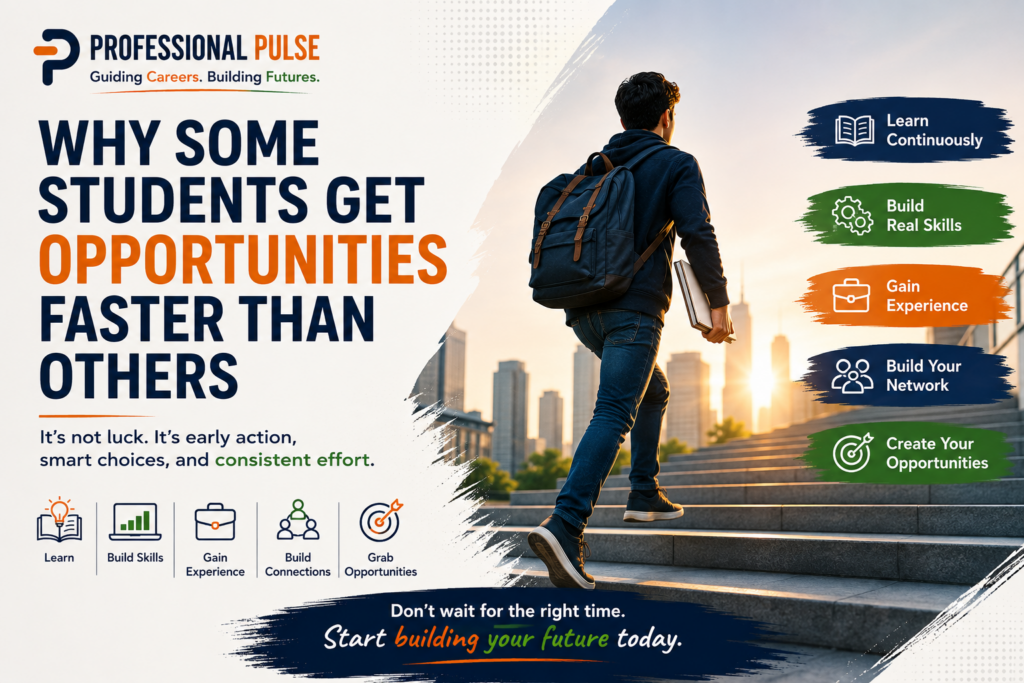
Why Some Students Get Opportunities Faster Than Others

A few months ago, I was talking to two students who were both looking for their first internship.

Both were studying similar courses.

Their academic performance was almost the same.

Both wanted to build a good career.

But their approach was completely different.

One student was waiting for the college placement process.

The other had already started applying to companies, talking to professionals on LinkedIn, working on small projects, and improving his communication.

Neither student was necessarily smarter.

The difference was simple:

One was waiting for an opportunity.

The other was preparing for one.


This Happens More Often Than You Think

Many students spend most of college asking:

“What should I study?”

That’s important.

But there’s another question that doesn’t get asked enough:

“What can I actually do with what I’ve studied?”

Because when you enter the job market, your degree is only one part of the conversation.

An employer may ask:

“Have you worked on a real project?”

“Can you explain what you learned?”

“How would you solve this problem?”

“How comfortable are you communicating with others?”

“What have you done outside your classroom?”

These questions can be difficult if your entire college experience has been about attending classes and preparing for exams.


Marks Matter. But They Aren’t the Whole Story.

I’m not going to tell students that academics don’t matter.

They do.

Good academic performance shows discipline and understanding.

But imagine two candidates with similar marks.

Candidate A has a degree and several certificates.

Candidate B has a degree, one relevant project, an internship, decent communication skills, and can confidently explain what they have learned.

Who has given the employer more reasons to say yes?

That’s the difference between being qualified and being employable.


You Don’t Need to Do Everything.

This is where students sometimes get overwhelmed.

They think they need:

10 certificates.

5 internships.

A perfect LinkedIn profile.

Excellent communication.

Multiple projects.

And somehow a 9+ CGPA.

No.

Start with one thing.

Learn one useful skill.

Then use it.

Build something.

Then show it.

Take an internship.

Learn from the experience.

Talk to someone in the industry.

Repeat.

Small actions compound.


Here’s What I Would Tell Any Student

Don’t wait until your final semester to ask,

“What am I going to do after graduation?”

Start asking that question much earlier.

Not because you need to have your entire life planned.

But because early exploration gives you something incredibly valuable:

time to make mistakes.

You can try a field and realize you don’t like it.

You can learn a skill and decide it’s not for you.

You can attend an interview and perform badly.

You can send a networking message and receive no response.

That’s okay.

You’re learning.

And every experience gives you more information about yourself and the career you want.


So Why Do Some Students Get Opportunities Faster?

Usually, it’s not one magical quality.

They simply start earlier.

They experiment more.

They build relationships.

They gain experience.

They learn from rejection.

And most importantly—

they don’t wait until they feel completely ready.


A Small Challenge

If you’re a student reading this, do one thing this week:

Apply for one opportunity you genuinely want.

Don’t worry about whether you’re perfectly qualified.

Read the requirements.

See where you match.

See where you need to improve.

Then apply.

Because sometimes the first opportunity doesn’t come after you’re ready.

It comes because you were willing to try.

Ready to Start Building Your Career?

If you’re a student wondering where to start, you don’t have to figure everything out alone.

At Professional Pulse, we help students move from “I don’t know what to do” to “I know what I’m working towards.”

Career Guidance — Understand yourself and explore suitable career paths.

Career Readiness Program — Build practical skills, communication, confidence, and workplace readiness.

Internship Opportunities — Gain real-world experience and learn how the workplace actually works.

Want Regular Career Guidance?

Join our Professional Pulse WhatsApp Community where we regularly share:

  • Career guidance and practical tips
  • Internship and job opportunities
  • Career workshops and webinars
  • Skill-building resources
  • Important updates for students

It’s a space for students who want to learn, connect, and become career-ready.

👉 Join the Professional Pulse WhatsApp Community and start building your career with us.

Don’t wait until graduation to become employable. Start building your skills, experience, and confidence today.

Your college years aren’t just preparation for your career.

They are the beginning of your career.

Don’t spend them only collecting marks and certificates.

Use them to discover what you can actually do.

Don’t wait for opportunities. Start becoming ready for them.

Published