Your first job teaches you much more than the work mentioned in your job description.
You learn how teams communicate.
How deadlines actually work.
How managers think.
How problems are solved.
And, most importantly, how you work with other people.
Technical skills matter, but your everyday habits can strongly influence how others experience working with you.
The good news?
You don’t need years of experience to develop professional habits.
You can start from Day One.
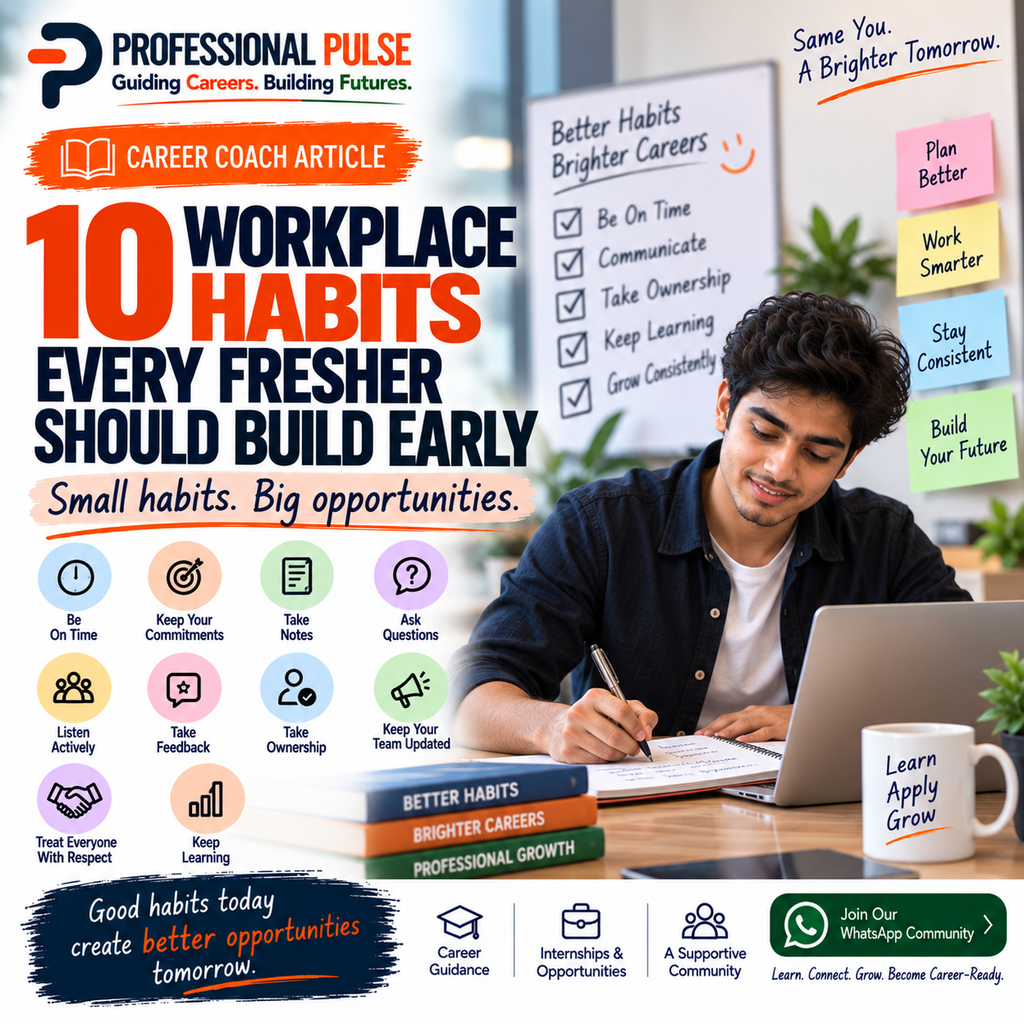
- Be On Time
Punctuality is a simple way of showing respect for other people’s time.
Whether it’s:
A meeting
A training session
A client call
A project deadline
Try to be prepared before the actual start time.
Being occasionally late can happen.
But repeatedly being late without communicating can become a pattern people notice.
Don’t just arrive on time. Be ready to work.
- Keep Your Commitments
If you say:
“I’ll send it by 5 PM.”
Try your best to send it by 5 PM.
And if something unexpected happens?
Don’t disappear.
Communicate early.
For example:
“I’m still working on the report. I may need another hour to complete it properly. I’ll share it by 6 PM.”
People can usually understand a delay.
What creates frustration is silence.
- Take Notes
Your first few weeks will be full of information.
Processes.
Passwords and tools.
Instructions.
Names.
Workflows.
Don’t expect yourself to remember everything.
Maintain a simple notebook or digital document.
Write down:
Important instructions
Process steps
Questions
Feedback
Common mistakes
Things you need to follow up on
Good notes reduce repeated questions and help you become independent faster.
- Ask Questions—But Think First
Asking questions is part of learning.
But before asking:
“How do I do this?”
Spend a few minutes trying to understand the problem yourself.
Then ask a specific question.
Instead of:
“I don’t understand this.”
Try:
“I understood the first two steps, but I’m not sure how to handle the final part. Could you guide me?”
This shows curiosity and effort.
- Learn to Listen
Being professional doesn’t mean always having something to say.
Sometimes the best thing you can do is listen.
During meetings:
Don’t interrupt unnecessarily.
Pay attention to requirements.
Take notes.
Ask questions when needed.
Confirm important instructions.
You may learn more by listening carefully than by trying to prove how much you know.
- Take Feedback Seriously
Your first few months may involve a lot of corrections.
Don’t treat every correction as criticism of you personally.
Instead, ask:
“What can I do better next time?”
If your manager says your report needs improvement, don’t just fix that one report.
Understand why it needed improvement.
Then apply that learning to the next one.
That’s how feedback becomes growth.
- Take Ownership
There is a big difference between:
“Nobody told me.”
and:
“I should have checked this. I’ll make sure it doesn’t happen again.”
Ownership doesn’t mean taking blame for everything.
It means being willing to take responsibility for what is within your control.
If you make a mistake:
Acknowledge → Fix → Learn → Prevent
That’s a professional response.
- Keep Your Team Updated
You don’t need to send constant messages.
But when something important changes, communicate.
For example:
The task is delayed.
You found a problem.
You completed an important step.
You need support.
The requirement has changed.
A short, clear update can prevent unnecessary confusion.
Good professionals don’t make people guess what’s happening.
- Treat Everyone With Respect
Your manager isn’t the only person who matters.
Be respectful to:
Interns
Security staff
Office support staff
Colleagues
Seniors
Clients
Vendors
You don’t become more professional by being polite only to people who can help your career.
Respect should not depend on someone’s designation.
- Keep Learning
Your job description is not the limit of your career.
If you work in recruitment, learn more about communication, sourcing, data, and technology.
If you work in marketing, learn analytics, content, automation, and customer behaviour.
If you work in finance, explore tools and technology that are changing the field.
You don’t have to learn everything.
But keep asking:
“What skill would make me better at my work six months from now?”
Then start learning it.
The First Job Is Also a Habit-Building Phase
Your first job isn’t only about getting a salary.
It’s where you start developing your professional identity.
People gradually learn:
Can I depend on this person?
Do they communicate properly?
Do they take responsibility?
Do they learn from feedback?
Can I trust them with more responsibility?
You don’t build that reputation through one big achievement.
You build it through small actions repeated consistently.
A Simple Fresher Checklist
Before you finish your first month, ask yourself:
☐ Am I usually on time?
☐ Do I complete what I commit to?
☐ Do I communicate delays early?
☐ Do I take notes?
☐ Do I ask thoughtful questions?
☐ Do I listen carefully?
☐ Do I accept feedback?
☐ Do I take responsibility for my work?
☐ Do I treat people respectfully?
☐ Am I learning something new?
You don’t need ten perfect answers.
Choose one area to improve this week.
Then build from there.
Your first job may not be your dream job.
Your first manager may not be your ideal manager.
Your first team may not be perfect.
But almost every workplace can teach you something about becoming a better professional.
So don’t focus only on:
“What am I getting from this job?”
Also ask:
“What kind of professional am I becoming because of this experience?”
Because skills can open doors.
But professional habits help you grow after you walk through them.
Keep Growing with Professional Pulse
At Professional Pulse, we believe career readiness goes beyond a degree.
Through career guidance, workshops, skill-building resources, internships, and career opportunities, our goal is to help students and freshers become better prepared for the professional world.
Learn. Connect. Grow. Become Career-Ready.
#ProfessionalPulse #Professionalism #CareerReadiness #Freshers #Students #WorkplaceSkills #CareerGrowth #FirstJob #CareerGuidance