

Have you ever looked at a job description and thought, “I’m interested in this role, but I’m probably not good enough”?
Or wanted to speak during a meeting but stayed quiet because you were afraid of saying something wrong?
Maybe you’ve delayed applying for an internship because you felt other candidates were more qualified.
If any of this sounds familiar, you’re not alone.
Starting a career can be intimidating. You see people with impressive skills, experience, and confidence, and it’s easy to feel like you’re falling behind.
But here’s something important to understand:
You don’t have to feel confident about everything before you begin. You build confidence by learning, practicing, and taking action.
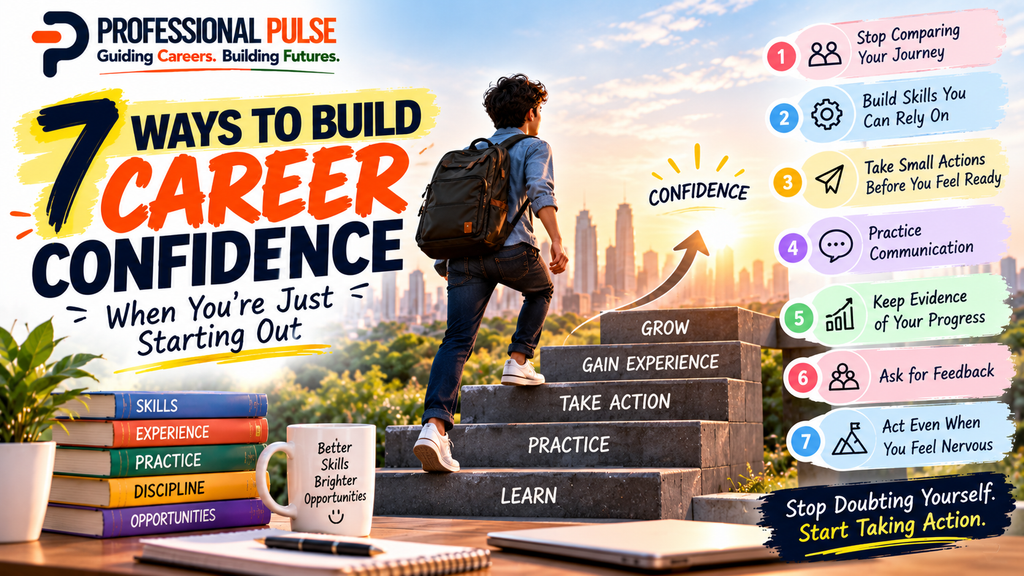
Here are seven ways to start building it.
1. Stop Comparing Your Beginning With Someone Else’s Progress
LinkedIn can make it seem like everyone your age is getting promoted, landing impressive jobs, or building successful careers.
But you’re seeing selected moments from other people’s journeys—not the complete picture.
Someone may have more experience because they started earlier. Someone else may have better communication skills because they’ve had more opportunities to practice.
That doesn’t mean you’re incapable.
Instead of asking, “Why am I not where they are?” ask yourself:
“What can I learn from where they are, and what is my next step?”
Use other people’s progress as inspiration, not as a reason to doubt yourself.
2. Build Skills That Give You Something to Rely On
Confidence becomes easier when you know you’ve prepared.
If you’re interested in HR, learn recruitment basics and practice using spreadsheets.
If you’re interested in marketing, study campaigns and create sample content.
If you want to work in data analytics, practice working with datasets and explaining your findings.
Choose skills relevant to the roles you want to pursue.
Then practice them consistently.
You don’t need to master everything at once. Focus on becoming a little more capable every week.
Preparation won’t eliminate every doubt, but it gives you a stronger foundation to act.
3. Take Small Actions Before You Feel Completely Ready
Imagine you’ve found an internship that interests you.
You meet most of the requirements, but you’re worried because you don’t meet every single one.
You have two choices.
You can wait until you feel fully qualified, or you can assess the role honestly, prepare your application, and apply if you’re a reasonable match.
The same principle applies to starting a project, reaching out to a professional, or sharing your work.
Start with actions that are challenging but manageable.
You don’t have to begin with your biggest fear.
Take one step that stretches you without overwhelming you.
Then take another.
4. Practice Communication in Low-Pressure Situations
Many students worry that their English, speaking ability, or presentation skills aren’t good enough.
The answer isn’t to wait until you become a perfect communicator.
Start practicing in everyday situations.
- Explain a concept you’ve learned in your own words.
- Record a short voice note summarizing a topic.
- Ask one question during a class, meeting, or webinar.
- Practice introducing yourself in 30 seconds.
- Explain a project to a friend.
Remember, effective communication isn’t only about fluent English.
It’s also about organizing your thoughts, listening carefully, asking useful questions, and expressing ideas clearly.
You can develop these abilities through regular practice.
5. Keep Evidence of Your Progress
When you’re feeling uncertain, you may forget how much you’ve already learned.
That’s why it’s useful to maintain a simple record of your progress.
Write down:
- Skills you’ve developed
- Projects you’ve completed
- Problems you’ve solved
- Feedback you’ve received
- Situations you handled better than before
- Tasks you can now do independently
For example, you might remember struggling with Excel formulas a month ago. Today, you’re using them to prepare a useful report.
That’s progress.
It may not feel dramatic, but it shows that your abilities are changing.
Don’t measure yourself only by what you haven’t achieved. Notice what you can do now that you couldn’t do before.
6. Ask for Feedback Instead of Guessing
Sometimes, we assume we’re not good enough without actually knowing what needs improvement.
You may think your resume is terrible when it only needs a few changes.
You may believe your interview answers are weak when you simply need more practice.
You may assume your communication skills are poor when the real issue is nervousness.
Ask a teacher, mentor, experienced colleague, or trusted professional for specific feedback.
Instead of asking, “Am I good enough?” try asking:
- What’s one strength I should build on?
- What’s one area I should improve?
- What would make this project or application stronger?
Feedback gives you something concrete to work on.
You don’t have to agree with every opinion, but you can use thoughtful feedback to make better decisions.
7. Learn to Act Even When You Feel Nervous
Confidence doesn’t mean you’ll never feel nervous.
You might still feel anxious before an interview.
You might still hesitate before publishing your first LinkedIn post.
You might still question yourself when taking on a new responsibility.
The goal isn’t to eliminate every uncomfortable feeling.
It’s to learn that you can experience discomfort and still take a reasonable next step.
Apply for the internship.
Ask the question.
Present your idea.
Start the project.
Prepare, do your best, and learn from the outcome.
Every time you take action, you gain experience that can help you handle similar situations in the future.
You don’t need zero fear. You need a plan for moving forward despite it.
Your 7-Day Career Confidence Challenge
You don’t need to transform your personality in a week. Start with these small actions.
Day 1: Write down three things you’re already good at or have improved.
Day 2: Spend 20 minutes practicing one career-relevant skill.
Day 3: Explain something you’ve learned to another person.
Day 4: Ask for feedback on your resume, profile, or project.
Day 5: Take one action you’ve been postponing.
Day 6: Connect with a professional or someone whose career interests you.
Day 7: Reflect on what you learned and choose your next step.
Keep the challenge manageable. The aim is to build a habit of taking action, not to create another source of pressure.
One Important Reminder
Not every application will succeed.
Not every conversation will go smoothly.
Not every attempt will produce the result you hoped for.
That’s part of learning.
Your confidence shouldn’t depend entirely on whether every attempt succeeds. It can also come from knowing that you’re preparing, improving, and willing to try again.
You cannot control every outcome, but you can influence how you prepare and respond.
Ask Yourself This Today
“What would I try this week if I stopped waiting to feel completely ready?”
Maybe it’s applying for an internship.
Maybe it’s starting a portfolio.
Maybe it’s speaking up, asking for feedback, or contacting someone who can guide you.
Choose one thing.
Prepare for it.
Take the step.
Then learn from what happens.
Confidence isn’t a requirement you must meet before starting your career. It’s something you can develop along the way.
Professional Pulse
Learn. Connect. Grow. Become Career-Ready.
Follow Professional Pulse for practical career guidance, skill-building resources, internships, workshops, and opportunities for students and young professionals.
Join our WhatsApp Community to stay connected with career resources and relevant opportunities.