Getting your first job is exciting.
You finally have an opportunity to earn, learn, and start building the career you’ve been thinking about for years.
But there’s something I wish more students understood before their first day at work.
Getting selected is one achievement. Learning how to become a good professional is another.
Your first few months at work are not just about completing tasks.
They’re about learning how to work with people, handle responsibility, and build trust.
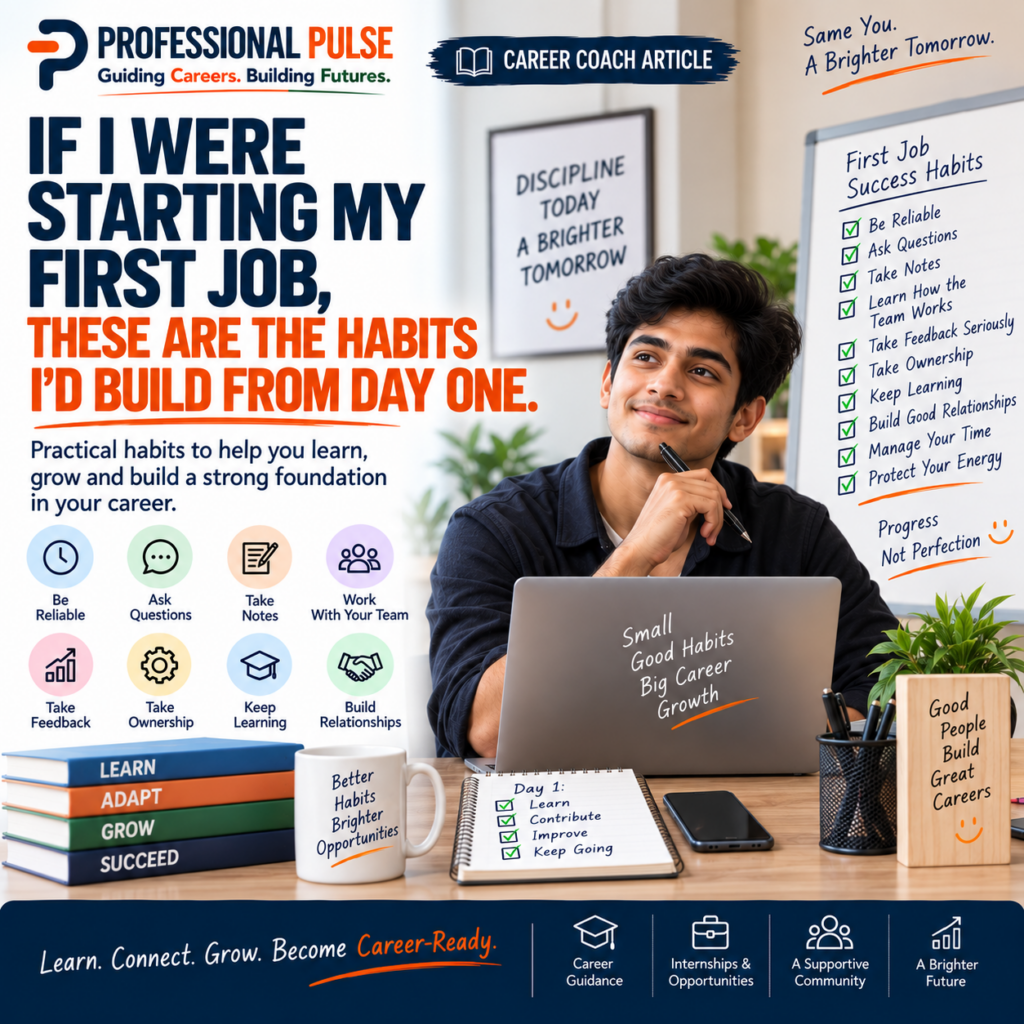
If I were starting my first job tomorrow, these are the habits I’d focus on.
1. I’d Be Reliable
I wouldn’t try to impress everyone on my first day.
I’d focus on being someone my team could depend on.
That means showing up on time, completing the work I’ve committed to, and communicating if something is going to be delayed.
It sounds simple.
But when a manager knows they can rely on you, it makes a difference.
You don’t have to be the most talented person in the room to become valuable.
Start by being dependable.
2. I’d Ask Questions
When you’re new, you won’t know everything.
You may not understand a process.
You may be unsure about a task.
You may not know how your team prefers to work.
And that’s okay.
I’d rather ask a thoughtful question than spend three hours doing something incorrectly because I was afraid of looking inexperienced.
Before asking, I’d try to understand the problem myself.
Then I’d ask clearly:
“I’ve tried this approach, but I’m stuck here. Could you help me understand what I should do next?”
That’s a much better habit than pretending everything is clear.
3. I’d Take Notes
On my first day, I’d carry a notebook or keep a place to record important things.
Names.
Processes.
Instructions.
Questions.
Feedback.
Things I need to remember.
Because when you’re new, there’s a lot of information coming at you.
You won’t remember everything.
And that’s normal.
Taking notes shows that you’re paying attention and helps you become more independent over time.
4. I’d Learn How My Team Works
Every workplace has its own way of doing things.
Some teams communicate through email.
Others use chat tools.
Some have daily meetings.
Some expect you to share updates at the end of the day.
I’d spend time understanding these expectations instead of assuming that the way I worked in college is automatically the right way to work here.
I’d observe how people communicate, how work is assigned, and how decisions are made.
Not to copy everyone.
But to understand the environment I’m part of.
5. I’d Take Feedback Seriously
This one can be difficult.
Imagine you’ve worked hard on something, and your manager tells you it needs improvement.
Your first reaction might be to defend yourself.
I understand.
But I’d try to pause and listen.
I’d ask:
“What would you like me to improve?”
Then I’d work on it.
You don’t have to agree with every piece of feedback.
But learning how to receive it professionally can help you grow.
Your first job is a place to learn, not a place to prove that you already know everything.
6. I’d Take Ownership of My Work
If I make a mistake, I’d try to acknowledge it and understand how to fix it.
If I finish a task, I’d check whether there’s anything else I need to do.
If I commit to something, I’d follow through.
Taking ownership doesn’t mean doing everything alone.
It means not disappearing when something becomes difficult.
A good professional knows when to solve a problem independently and when to ask for help.
7. I’d Keep Learning Outside My Job Description
Your job will teach you a lot.
But I’d still spend some time improving skills that could help me in the future.
Maybe it’s Excel.
Maybe it’s communication.
Maybe it’s understanding the industry.
Maybe it’s learning a new tool.
Maybe it’s getting better at writing professional emails.
I wouldn’t try to learn everything at once.
I’d choose one useful skill and spend a little time each week developing it.
Because the career you want in three years may require skills you haven’t started building yet.
8. I’d Build Good Relationships
You don’t have to become best friends with everyone at work.
But I’d make an effort to be respectful, helpful, and approachable.
I’d get to know my teammates.
I’d appreciate people who help me.
I’d avoid unnecessary gossip.
And I’d remember that the way I treat people matters.
Your professional reputation isn’t built only through your work.
It’s also built through how people experience working with you.
9. I’d Stop Comparing My Beginning With Someone Else’s Middle
This is something many freshers struggle with.
You join a company and see someone who is already confident, skilled, and comfortable in their role.
Then you start thinking:
“Why am I not like that?”
Remember, they may have years of experience.
You are just starting.
Don’t expect yourself to perform like someone who has already been doing the job for a long time.
Compare yourself with where you were last month.
Are you learning?
Are you improving?
Are you becoming more independent?
That’s what matters.
10. I’d Protect My Energy
Being a good professional doesn’t mean saying yes to everything.
I’d learn to manage my time, take breaks, and communicate when my workload becomes difficult to handle.
I’d also remember that my entire identity doesn’t have to come from my job.
Work matters.
But so do health, family, friendships, and the things that make life meaningful.
Building a career is a long journey.
You don’t need to burn yourself out in the first few months.
A Simple First-Week Checklist
If I were starting a new job, I’d focus on these things during my first week:
- Understand my role and responsibilities.
- Learn the team’s basic processes.
- Save important contact details and resources.
- Ask questions when I need clarity.
- Take notes during training and meetings.
- Complete my first tasks carefully.
- Ask for feedback on how I’m doing.
You don’t have to master your job in a week.
You just need to begin building good habits.
What If Your First Job Isn’t Perfect?
Let’s be realistic.
Your first job may not be exactly what you imagined.
The work may be challenging.
Your manager may have a different working style.
You may discover that you don’t enjoy a particular responsibility.
That doesn’t mean you’ve made a terrible career decision.
Give yourself time to learn and understand the role.
At the same time, pay attention to how you’re being treated and whether the opportunity is helping you grow.
You can learn from a difficult experience without accepting an unhealthy or disrespectful work environment.
Your first job is important.
But it isn’t your last opportunity.
Start Building Your Career Before Your First Day
At Professional Pulse, we believe career readiness is about more than getting selected.
It’s about helping students become confident, capable, and prepared for the professional world.
We support students through:
Career Guidance — Understand your strengths and career direction.
Career Readiness — Build communication, confidence and workplace skills.
Practical Exposure & Opportunities — Gain experiences that help you build and explain your professional journey.
Join the Professional Pulse WhatsApp Community
Stay connected with:
- Career guidance and practical tips
- Internship and job opportunities
- Workshops and webinars
- Skill-building resources
- Workplace preparation advice
Learn. Connect. Grow. Become Career-Ready.
Join our WhatsApp Community and keep learning with a community that supports your career journey.
Your first job is not just about what you earn.
It’s also about what you learn, how you grow, and the kind of professional you become.
You don’t need to know everything on day one.
You just need to be willing to learn, take responsibility, and keep improving.
Start small. Build good habits. Earn trust.
And remember: