

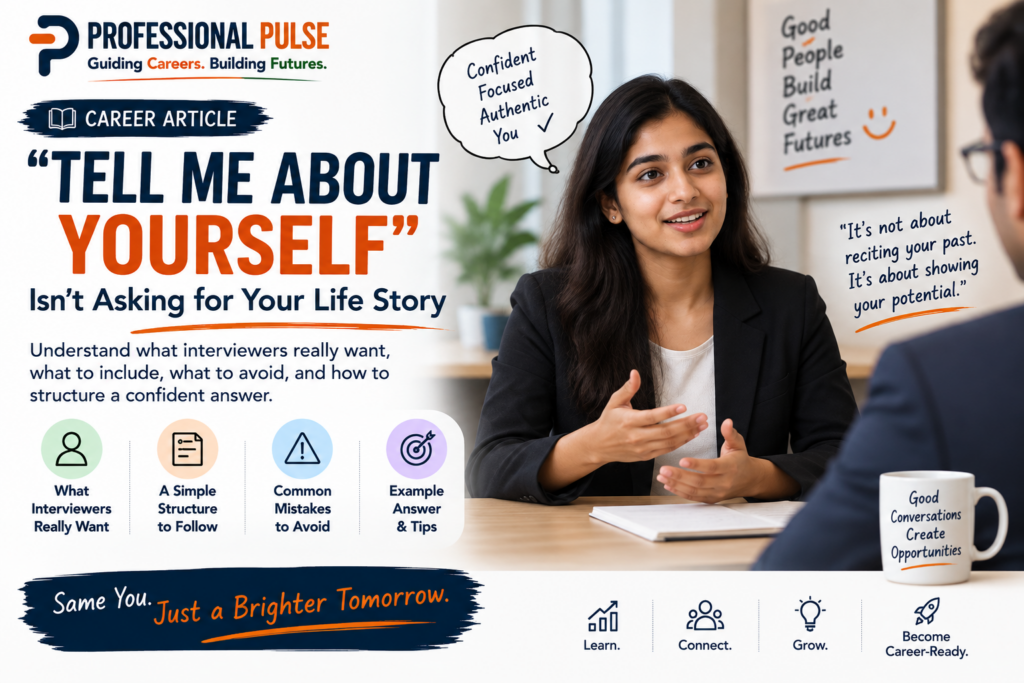
Almost every student preparing for an interview knows this question is coming.
And still, many panic when they hear it.
“Tell me about yourself.”
Some students start from their childhood.
Some repeat everything written on their resume.
Some talk only about their degree.
And some simply say:
“My name is Rahul. I am from Lucknow. I completed my graduation from XYZ College…”
Then they stop.
The problem isn’t that students don’t have anything to say.
The problem is that they don’t understand what the interviewer is actually asking.
What Does the Interviewer Really Want to Know?
When an interviewer says, “Tell me about yourself,” they usually aren’t asking for your entire biography.
They already have your resume.
What they want is a quick understanding of:
- Who are you professionally?
- What is your background?
- What have you learned or worked on?
- What are you interested in?
- Why are you sitting in this interview?
Think of it as your professional introduction.
Not your life story.
A Simple Structure You Can Follow
You don’t need to memories a perfect answer.
But having a structure helps.
1. Start With Your Present
Who are you right now?
For example:
“I’m currently pursuing my MBA with a specialization in Human Resources, and I’ve been actively exploring recruitment and talent acquisition.”
Simple.
You immediately tell the interviewer where you are and what you’re interested in.
2. Briefly Mention Your Background
Talk about relevant education, experience, internships or projects.
For example:
“During my studies, I worked on projects related to employee engagement and also completed an internship where I gained exposure to candidate sourcing and screening.”
You don’t need to explain everything.
Pick the experiences that are relevant to the role.
3. Talk About What You’ve Developed
What skills or strengths have you started building?
For example:
“Through these experiences, I’ve developed my communication and research skills, and I’ve also learned how important, structured processes are in recruitment.”
Notice the difference.
You’re not simply listing skills.
You’re connecting them to your experience.
4. End With Your Direction
Where are you trying to go?
Why are you interested in this opportunity?
For example:
“I’m now looking for an opportunity where I can continue developing my HR skills, gain practical experience, and contribute to a professional team.”
Now the interviewer understands why you’re there.
The Formula Is Simple
Present → Background → Skills/Experience → Direction
That’s it.
You don’t need fancy English.
You don’t need complicated words.
You need clarity.
Here’s a Complete Example
Let’s say you’re a B.Com student applying for a recruitment internship.
You could say:
“I’m currently pursuing my B.Com and have developed a growing interest in recruitment and human resources. During my studies, I’ve worked on team projects and participated in college activities that helped me improve my communication and coordination skills. I’ve also been learning more about recruitment and talent acquisition through online resources and practical exercises. I’m now looking for an opportunity where I can gain hands-on experience, learn from professionals, and start building my career in HR.”
Is this the only correct answer?
No.
And that’s important.
Your answer should sound like you.
Don’t copy someone else’s introduction word for word.
Common Mistakes Students Make
1. Starting With Personal Details
Your name, hometown and family background usually aren’t the most important part of a professional introduction unless the interviewer specifically asks.
Start with where you are professionally.
2. Repeating Your Resume
The interviewer can read your resume.
Use your introduction to connect the important parts of your journey.
3. Giving a Memorized Speech
You can prepare your points.
But don’t memorise every word.
When students memorise answers, they often sound unnatural.
And if they forget one sentence, they panic.
Understand your story instead.
Then explain it naturally.
4. Talking for Too Long
Your answer doesn’t need to be five minutes long.
For most fresher interviews, 60–90 seconds is usually enough to give a clear introduction, unless the interviewer asks follow-up questions.
Be concise.
You can always share more later.
5. Forgetting Why You’re Here
Your introduction should eventually connect to the opportunity.
Don’t just tell the interviewer who you are.
Help them understand:
Why this role makes sense for you.
Practice This Before Your Next Interview
Open your phone and record yourself answering:
“Tell me about yourself.”
Then listen to it.
Ask yourself:
- Do I sound natural?
- Am I clear about what I’m interested in?
- Did I mention relevant experience?
- Did I explain what I’m looking for?
- Am I talking for too long?
You might feel awkward watching yourself.
That’s normal.
But the more you practice, the more natural it becomes.
Interviews Are a Skill You Can Practice
Many students think some people are simply “naturally good” at interviews.
That’s not always true.
Some people have simply practiced more.
They’ve learned how to:
- Introduce themselves clearly
- Explain their projects
- Handle difficult questions
- Communicate under pressure
- Think before answering
These are skills.
And skills can improve with practice.
At Professional Pulse, we help students become more prepared for the professional world through:
Career Guidance — Understand your strengths and career direction.
Career Readiness — Build communication, confidence and workplace skills.
Practical Exposure & Opportunities — Gain experiences that help you build and explain your professional journey.
Join the Professional Pulse WhatsApp Community
Stay connected with:
- Career guidance and practical tips
- Internship and job opportunities
- Workshops and webinars
- Interview and career preparation resources
- Important career updates
Learn. Connect. Grow. Become career-ready.
👉 Join the Professional Pulse WhatsApp Community and keep preparing for the opportunities ahead.
“Tell me about yourself” isn’t a test of how much you can talk.
It’s an opportunity to help someone understand your story.
So don’t memorise someone else’s answer.
Take a few minutes and think about your own:
Where are you now?
What have you learned or worked on?
What can you do?
Where do you want to go next?
When you know those answers, introducing yourself becomes much easier.
Your story doesn’t have to be extraordinary.