

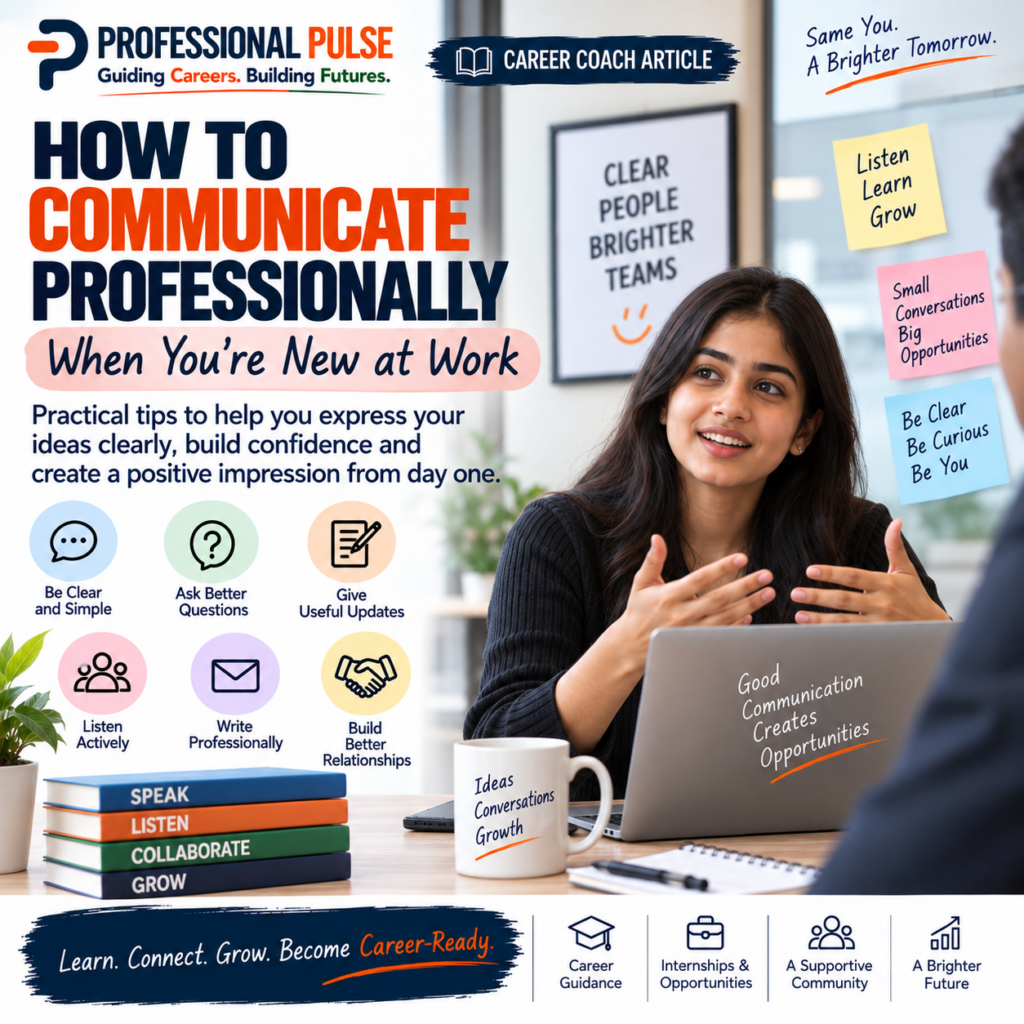
You know the work.
You understand the task.
But when someone asks you to explain it, you suddenly struggle to find the right words.
You start thinking:
“What if I say something wrong?” “What if they think I don’t know anything?” “Should I speak in English?” “What if my manager asks a follow-up question?”
If you are a fresher, this is completely normal.
Professional communication is not about speaking perfect English or using complicated words.
It is about making your thoughts easy for another person to understand.
And that is a skill you can practice.
- Stop Trying to Sound “Professional”
One common mistake freshers make is trying too hard to sound professional.
They use complicated words, long sentences, or phrases they wouldn’t normally use.
Instead, focus on being clear and natural.
Instead of:
“As per my understanding regarding the aforementioned task…”
Say:
“As I understand it, the task is…”
Simple language can still be professional.
Clarity is more important than complexity.
- Learn to Give a Clear Update
Imagine your manager asks:
“What’s the status of this task?”
Don’t simply say:
“I’m working on it.”
Give a useful update.
Try:
“I’ve completed the first two steps. I’m currently working on the third step and expect to finish it by 4 PM.”
Now the other person knows:
What you completed
What you’re doing
What remains
When it will be completed
That’s professional communication.
- Ask Questions Properly
Being new means you will have questions.
That’s okay.
But instead of saying:
“I don’t understand this.”
Try:
“I understood the first part, but I’m not clear about how we should handle the second step. Could you please explain that part?”
This shows that you have already tried to understand the task.
A good question doesn’t just ask for an answer.
It shows that you are thinking.
- Don’t Be Afraid to Say “I Don’t Know”
One of the biggest mistakes a fresher can make is pretending to know something they don’t.
You don’t have to know everything.
You can say:
“I’m not sure about that yet. Let me check and get back to you.”
Or:
“I haven’t worked on this before, but I’ll look into it.”
That’s much better than confidently giving incorrect information.
Being honest about what you don’t know can actually build trust.
- Learn the Art of Listening
Communication isn’t only about speaking.
A good professional also knows how to listen.
During meetings or discussions:
Don’t interrupt unnecessarily.
Pay attention to the actual requirement.
Take notes.
Ask questions when something is unclear.
Confirm important instructions.
For example:
“Just to confirm, you want me to complete the report by Friday and share the final version with the team. Correct?”
That one sentence can prevent hours of misunderstanding.
- Think Before You Speak
You don’t have to answer immediately.
If someone asks you a question and you need a moment, take it.
You can say:
“Let me think about that for a moment.”
Then structure your answer.
A simple framework is:
Point → Reason → Example
For example:
Point: “I think we should follow up with these candidates today.”
Reason: “They have already shown interest but haven’t responded.”
Example: “We can send them a short WhatsApp reminder and call the high-priority candidates.”
Suddenly, your answer sounds much more structured.
- Professional Communication Includes Written Communication
Your communication skills are visible even when you’re not speaking.
Think about the messages you send on:
Slack
Teams
Compare:
“Sir pls check this.”
with:
“Hi Sir, I’ve shared the updated report for your review. Please let me know if any changes are required.”
The second message isn’t complicated.
It’s simply clear, respectful, and complete.
Before sending a professional message, quickly check:
Context + Purpose + Action
Does the person understand why you’re messaging, what you need, and what they should do next?
- You Don’t Need to Become an Extrovert
This is important.
Being a good communicator doesn’t mean talking constantly.
Some of the strongest professionals are naturally quiet.
You can be introverted and still:
Express your ideas
Ask good questions
Lead discussions
Give presentations
Communicate with clients
Build professional relationships
You don’t need to change your personality.
You need to improve your communication habits.
A 7-Day Communication Challenge
Try this for the next seven days.
Day 1: Ask one meaningful question.
Day 2: Give someone a clear work/study update.
Day 3: Practice explaining one topic in 60 seconds.
Day 4: Write one professional email or message.
Day 5: Speak once during a meeting or group discussion.
Day 6: Ask someone for feedback on your communication.
Day 7: Record yourself explaining something and identify one thing to improve.
Don’t worry about sounding perfect.
The goal is to become a little clearer and more confident every day.
Your Career Is Not Only About What You Know
Your knowledge may get you an opportunity.
But your ability to communicate that knowledge influences how people understand your contribution.
So don’t wait until you get your first job to start practicing.
Start in college.
Start during internships.
Start in group projects.
Start during presentations.
Start today.
Because professional communication isn’t about having the perfect words.
It’s about making your message clear, respectful, and useful.
Keep Growing with Professional Pulse
At Professional Pulse, we believe career readiness goes beyond a degree.
Through career guidance, workshops, skill-building resources, internships, and career opportunities, our goal is to help students and freshers become better prepared for the professional world.
Learn. Connect. Grow. Become Career-Ready.