

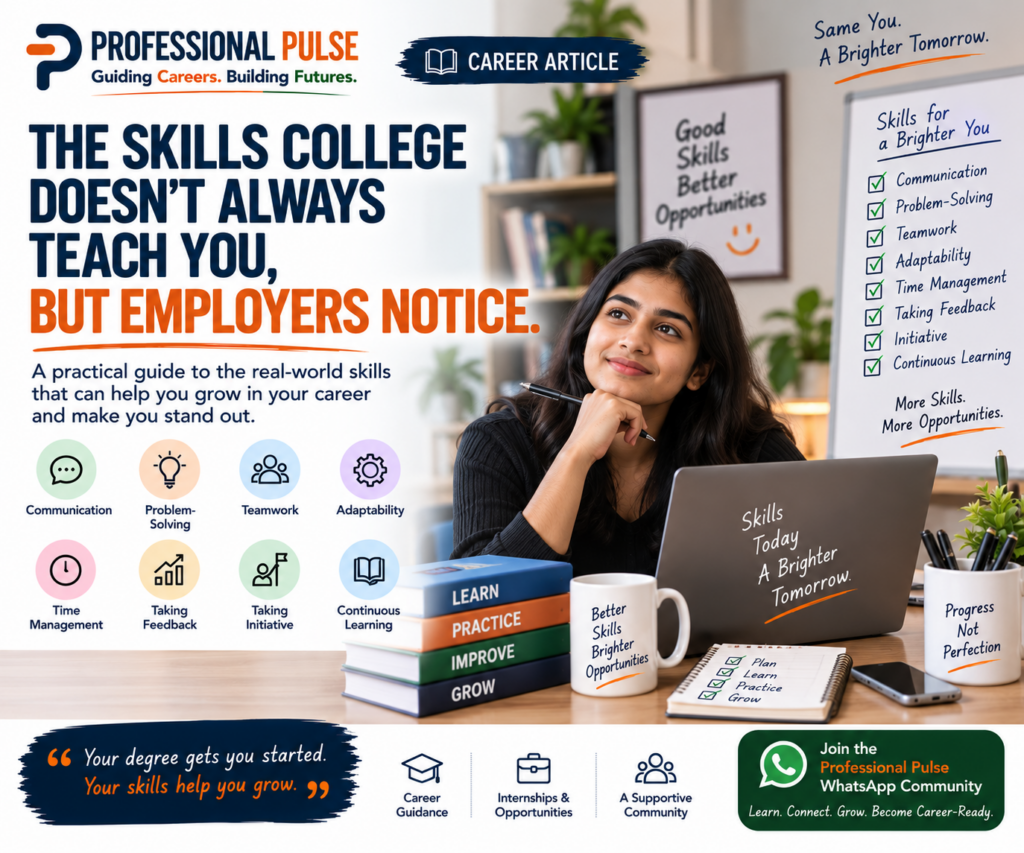
I’ve met students with impressive degrees who still feel unsure about starting their careers.
They have good marks. They’ve completed courses. They’ve collected certificates.
But when someone asks them, “What can you actually do?”, they struggle to answer.
And honestly, that’s understandable.
College teaches us many important things. But some of the skills we need at work are learned through practice, experience, and sometimes a few uncomfortable mistakes.
These are the skills that can help you become a better professional.
1. Communication
You may know the answer, but can you explain it clearly?
You may have a good idea, but can you share it with your team?
You may have a problem, but can you ask for help without feeling embarrassed?
Communication isn’t just about speaking fluent English.
It’s about expressing your thoughts, listening to others, and making sure people understand what you’re trying to say.
You can start practicing today.
Explain a project to a friend. Participate in a discussion. Ask a thoughtful question in class.
Small conversations build confidence over time.
2. Problem-Solving
At work, not everything will come with instructions.
Sometimes a customer will have a problem.
Sometimes a deadline will change.
Sometimes the information you need won’t be available.
What will you do then?
You don’t need to know everything immediately.
But you should learn how to break a problem into smaller parts, understand what is happening, and look for a practical solution.
Start with your everyday experiences.
If a college project isn’t going well, don’t just complain about it. Try to understand why and what you can change.
That’s how problem-solving becomes a real skill.
3. Teamwork
A lot of students are comfortable working alone.
But most workplaces require you to work with people who have different personalities, opinions, and ways of doing things.
You won’t always agree with everyone.
You won’t always get your preferred responsibility.
And sometimes, you’ll have to help someone else even when you have your own work to finish.
Learning to cooperate, communicate, and take responsibility for your part of a project is valuable.
Start by becoming someone your teammates can rely on.
4. Adaptability
The skills you learn today may not be enough for every opportunity tomorrow.
New tools will appear. Work processes will change. You may even discover that the career you thought you wanted isn’t the right fit for you.
That doesn’t mean you have failed.
It means you’re learning.
Be willing to explore new things, accept feedback, and improve your approach.
You don’t have to love every change.
But learning how to handle change without giving up is an important part of professional growth.
5. Time Management
You can be talented and still struggle if you regularly miss deadlines.
You can have good ideas and still lose opportunities if you don’t manage your responsibilities.
Time management isn’t about filling every minute of your day.
It’s about understanding what needs to be done, deciding what matters most, and making consistent progress.
Try this simple habit:
At the beginning of each day, write down the three most important things you want to complete.
Start with those.
You don’t need a complicated productivity system to become more organized.
6. Taking Feedback
This is one of the most underrated skills.
Imagine you’ve spent hours working on a project, and someone tells you that it needs improvement.
Your first reaction might be:
“But I worked so hard on it.”
I understand that feeling.
But feedback isn’t always a criticism of you as a person.
Sometimes, it’s simply information that can help you do better.
Learn to ask:
“What can I improve?”
And then actually work on it.
The ability to learn from feedback can help you grow much faster than trying to prove you’re always right.
7. Taking Initiative
You don’t always have to wait for someone to tell you what to do.
If you notice a problem, think about how you could help.
If you want to learn a skill, start exploring it.
If you’re interested in an industry, research it.
If you have an idea for a project, try building a small version of it.
Initiative doesn’t mean doing everything alone or ignoring instructions.
It means being willing to take the first step.
And sometimes, that first step is simply asking a good question.
You Don’t Need to Master Everything
Here’s something I want students to remember.
You don’t need to become excellent at every skill before you graduate.
You also don’t need to compare yourself with someone who already has years of experience.
Choose a few skills that matter for the career you’re exploring.
Practice them.
Look for opportunities to use them.
Then keep improving.
For example, if you’re interested in recruitment, you might start with communication, Excel, candidate research, and interview coordination.
If you’re interested in marketing, you might explore content creation, digital tools, customer research, and communication.
If you’re interested in finance, you might build your Excel, analytical, and financial reporting skills.
The right skills depend on the role.
But the habit of learning and applying what you know is useful in almost every career.
A Simple Challenge for This Week
Choose one skill from this article.
Don’t just save the post and forget about it.
Do something practical.
If you choose communication, record a one-minute introduction about yourself.
If you choose problem-solving, work on a small project and document how you solved a challenge.
If you choose Excel, build a simple budget or data tracker.
If you choose teamwork, volunteer to take responsibility for one part of a group project.
If you choose time management, plan your next seven days.
One small action is better than another week of saying, “I need to improve my skills.”
What Professional Pulse Believes
At Professional Pulse, we believe students deserve more than just a degree.
They deserve guidance to understand their strengths, opportunities to gain practical exposure, and support to become confident professionals.
Whether you’re exploring your career direction, preparing for interviews, or looking for internships, the goal is the same:
To help you become more prepared for the opportunities ahead. We help students become more prepared for the professional world through:
Career Guidance — Understand your strengths and career direction.
Career Readiness — Build communication, confidence and workplace skills.
Practical Exposure & Opportunities — Gain experiences that help you build and explain your professional journey.
Join the Professional Pulse WhatsApp Community
Get connected with career guidance, internship and job opportunities, workshops, and practical resources.
Learn. Connect. Grow. Become Career-Ready.
Join our WhatsApp Community and take one more step toward your professional future.
Your degree is important.
Your marks matter.
But don’t underestimate the value of the skills you build along the way.
The ability to communicate, solve problems, work with others, learn from feedback, and take responsibility can make a real difference in your career.
You don’t need to know everything today.
You just need to keep becoming more capable.
Your degree gets you started. Your skills help you grow.
What is one skill you’re going to work on this week?