

Your first year at work can feel overwhelming.
You’re learning a new role, understanding workplace culture, working with different people, making mistakes, meeting deadlines—and trying to figure out what you actually want from your career.
It’s easy to spend the entire year simply completing whatever tasks are assigned to you.
But your first year can be much more than that.
It can become the foundation for your next 5 years.
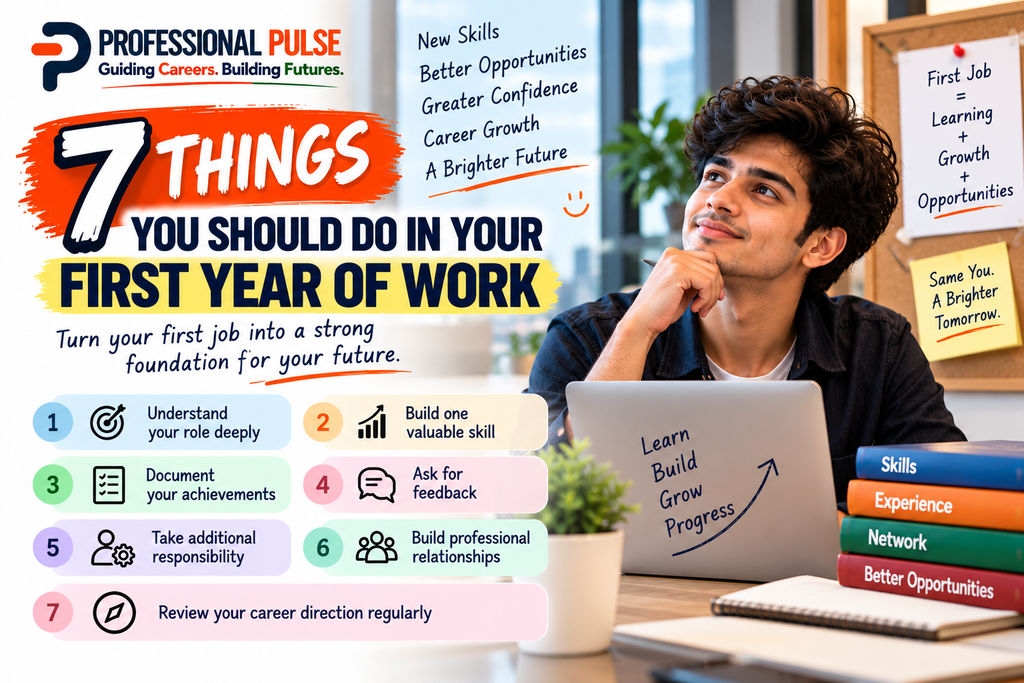
Here are 7 things you should intentionally do in your first year of work.
1. Understand Your Role Deeply
Don’t just learn what you have to do.
Understand why you are doing it.
Learn:
- How your work contributes to the team
- What your manager actually expects from you
- Which metrics or outcomes matter
- How your work affects customers or other departments
- What skills are important for your role
The better you understand your role, the more confidently you can contribute.
Don’t aim to just complete tasks. Aim to understand the work.
2. Build One Valuable Skill
Your job will expose you to many things.
But don’t try to become an expert at everything at once.
Pick one skill that can significantly increase your value.
For example:
- Excel & data analysis
- Communication
- Recruitment
- Sales
- Digital marketing
- Project management
- Coding
- Client handling
- AI tools
- Presentation skills
Ask yourself:
“If I become really good at one skill this year, which skill could create better opportunities for me?”
Then work on it consistently.
3. Document Your Achievements
This is something many freshers ignore.
Don’t wait until you need to update your resume.
Keep a simple record of:
- Projects you worked on
- Problems you solved
- Targets you achieved
- Processes you improved
- Positive feedback you received
- New responsibilities you handled
- Skills you developed
For example, instead of remembering:
“I worked on recruitment.”
You may later be able to say:
“Handled sourcing for multiple positions and improved the candidate pipeline by introducing a structured sourcing process.”
Your experience becomes more valuable when you can explain the impact you created.
4. Ask for Feedback
Don’t wait for your annual appraisal to find out how you’re doing.
Occasionally ask your manager:
“What is one thing I can improve in my work?”
The answer may not always be comfortable.
That’s okay.
Feedback gives you information about the gap between how you think you’re performing and how others experience your work.
Listen.
Improve.
Ask again.
That’s how professional growth happens.
5. Take Additional Responsibility
Once you become comfortable with your existing responsibilities, look for opportunities to contribute beyond them.
It could be:
- Helping a teammate
- Taking ownership of a small project
- Creating a process/document
- Training a new intern
- Volunteering for a presentation
- Solving a recurring problem
You don’t need to say yes to everything.
But occasionally ask:
“Is there anything else I can take ownership of?”
Additional responsibility can give you exposure to work that your original job description never mentioned.
6. Build Professional Relationships
Your career isn’t built only through your skills.
It’s also built through the people you work with and learn from.
Build genuine relationships with:
- Your teammates
- Managers
- Seniors
- People from other departments
- Industry professionals
- Mentors
You don’t need to network aggressively.
Start simply.
Be helpful.
Ask thoughtful questions.
Stay connected.
Learn from people’s experiences.
A strong professional network is built over time—not when you suddenly need a job.
7. Review Your Career Direction Regularly
Your first job may teach you something unexpected.
Maybe you discover that you enjoy working with clients.
Maybe you enjoy technology more than you expected.
Maybe you discover that sales isn’t for you.
Maybe you realize you want to move into management.
That’s valuable information.
Every few months, ask yourself:
What am I learning?
What am I becoming good at?
What kind of work do I want to do more of?
What should I learn next?
Your career direction doesn’t have to be perfect in your first year.
But it should be intentional.
Your First-Year Career Checklist
Before completing your first year, try to be able to say:
☑ I understand my role better than when I started.
☑ I developed at least one valuable skill.
☑ I can clearly explain some achievements from my work.
☑ I actively sought feedback.
☑ I took responsibility beyond basic tasks.
☑ I built meaningful professional relationships.
☑ I have a better idea of where I want to go next.
That’s a much better outcome than simply saying:
“I have one year of experience.”
Because experience isn’t just about the number of years you’ve worked.
It’s about what those years have taught you and what you’ve built during them.
One question to think about:
If you continue working exactly the way you are today for the next 12 months, where will it take your career?
If you don’t like the answer, you don’t need to change everything.
Start with one thing.
One skill.
One habit.
One responsibility.
One better decision.
Don’t just complete your first year. Use it to build the next stage of your career.
Professional Pulse Learn. Connect. Grow. Become Career-Ready.
Follow Professional Pulse for practical career guidance, skill-building resources, internships, workshops, and opportunities for students and young professionals.