
I’ve seen a lot of fresher resumes.
And many of them look almost identical.
Name. Degree. College. Marks. Certificates. Skills.
Then the student wonders:
“Why am I not getting interview calls?”
Sometimes, the problem isn’t that you don’t have anything to offer.
The problem is that your resume doesn’t make it obvious.
Your Resume Has a Very Short Job
Think about what happens when a recruiter receives hundreds of applications.
They don’t know you.
They don’t know how hard you worked.
They don’t know how much potential you have.
All they have is your resume.
So your resume has one important job:
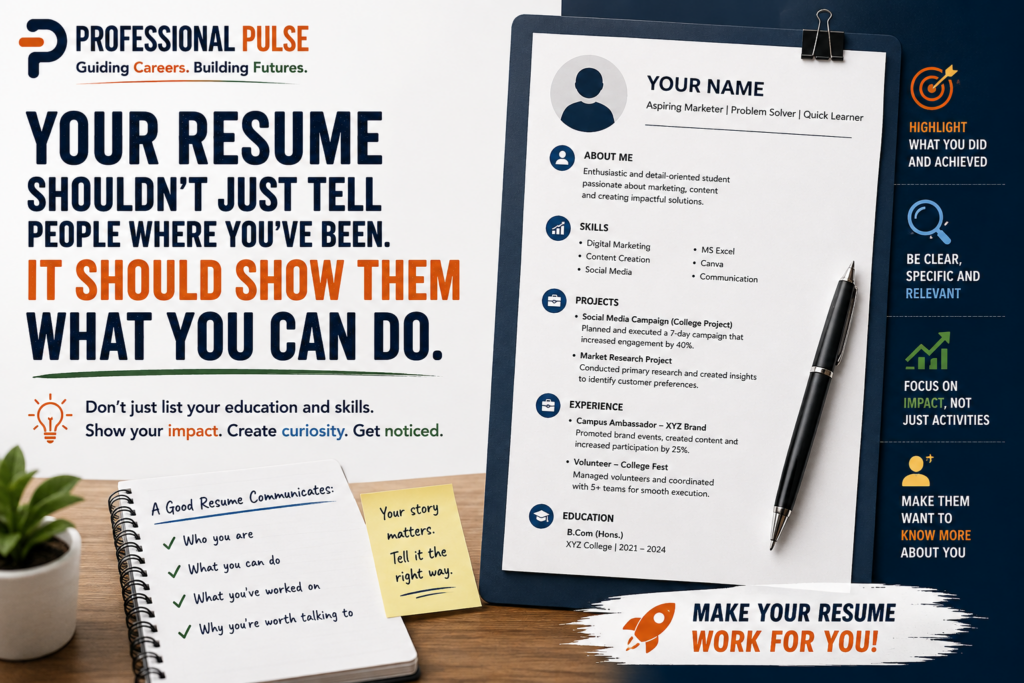
Make the recruiter want to know more about you.
It doesn’t need to tell your entire life story.
It needs to quickly answer:
Who are you?
What can you do?
What have you actually worked on?
Why might you be worth talking to?
“But I Don’t Have Any Experience.”
This is probably the most common thing I hear from students.
And sometimes I ask:
“What have you done during college?”
Then the answers start coming.
“I worked on a marketing project.”
“I helped organize our college fest.”
“I managed social media for our student club.”
“I built a website for a college project.”
“I volunteered at an event.”
“I helped my family business with Excel.”
That’s experience.
Maybe it isn’t formal employment yet.
But you’ve done something.
And that’s what your resume should communicate.
Don’t Just Write What You Did. Explain What You Contributed.
Here’s a simple difference.
Instead of:
“Worked on a college marketing project.”
Try:
“Developed a social media campaign for a college project and analyzed engagement across different content formats.”
The second version gives me something to understand.
What did you work on?
What did you actually do?
What did you learn?
Whenever possible, show the action and outcome.
You don’t need to invent impressive numbers.
Just be specific and honest.
Certificates Aren’t the Whole Story
Certificates can be useful.
But a resume filled with certificates doesn’t automatically demonstrate capability.
If you’ve completed a digital marketing course, tell me what you did with that knowledge.
If you’ve learned Excel, show me a project.
If you’ve learned coding, show me something you’ve built.
If you’ve studied recruitment, tell me about a practical project or experience.
Learning is good.
Applying what you learned is better.
Your Resume and LinkedIn Should Tell the Same Story
Here’s another mistake students make.
Their resume says they’re interested in marketing.
Their LinkedIn says they’re looking for finance opportunities.
Their projects show something completely different.
It’s confusing.
Your professional presence doesn’t need to be perfect.
But it should be consistent.
If you’re interested in a particular field, start building evidence around it.
Learn.
Create.
Share.
Connect.
Gradually, people should be able to understand what you’re working toward.
And Please Don’t Lie
This is important.
Don’t add skills you can’t actually use.
Don’t invent internships.
Don’t exaggerate projects.
Don’t copy someone else’s resume.
You may get past the first screening.
But eventually, someone will ask you about it.
And then you’ll have to explain something you never actually did.
A simple, honest resume is much stronger than an impressive-looking fake one.
A Simple Resume Test
Before sending your resume, give it to someone who doesn’t know you well.
Give them 30 seconds.
Then ask:
“What do you think I can do?”
If they can’t answer, your resume probably needs more clarity.
Your goal isn’t to make your resume complicated.
It’s to make your value easy to understand.
If You’re a Fresher, Start Building Your Resume Now
Don’t wait until placement season.
Start collecting your experiences.
Keep track of:
- Projects you’ve completed
- Skills you’ve actually used
- Internships
- Volunteer work
- Competitions
- Leadership responsibilities
- Freelance work
- Relevant achievements
You don’t need to wait until graduation to start building your professional story.
Start documenting it while you’re living it.
Ready to Become More Career-Ready?
At Professional Pulse, we help students go beyond simply earning a degree.
Career Guidance — Explore your strengths and find a direction that makes sense for you.
Career Readiness Program — Build practical skills, communication, confidence and workplace readiness.
Internship Opportunities — Gain real-world experience and create something meaningful to add to your professional story.
Join the Professional Pulse WhatsApp Community
Want regular career guidance and opportunities?
Our WhatsApp Community shares:
- Internship & job opportunities
- Career tips and practical advice
- Workshops and webinars
- Skill-building resources
- Important career updates
Learn. Connect. Grow. Become career-ready.
👉 Join the Professional Pulse WhatsApp Community and start building your professional journey today.
Your resume isn’t supposed to prove that you’re perfect.
It’s supposed to make someone curious enough to meet you.
So don’t ask:
“How can I make my resume look impressive?”
Ask:
“How can I make my real abilities easier to see?”
That’s a much better place to start.